

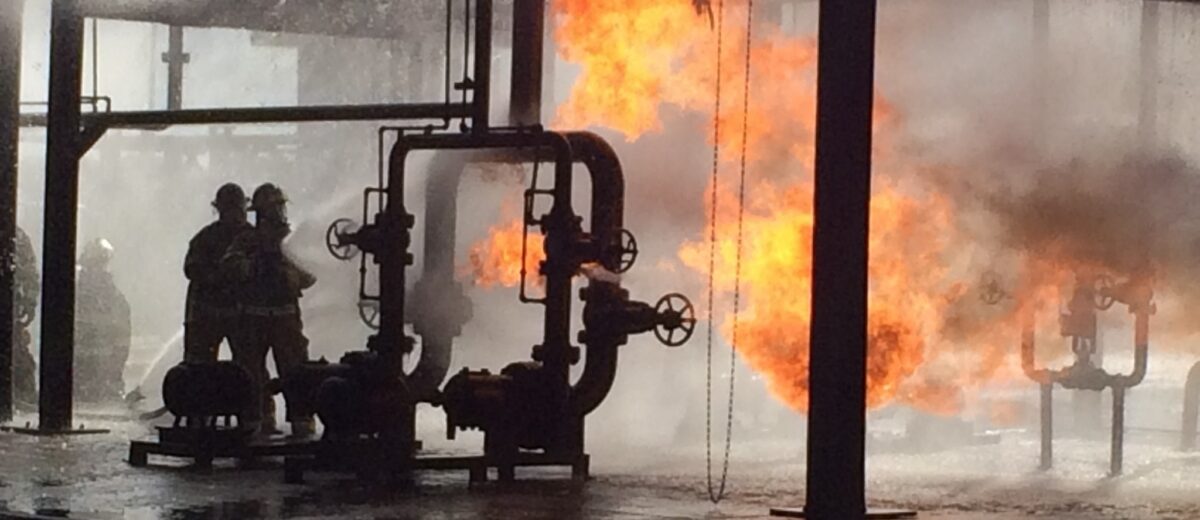
Best Firefighting Equipment for Industrial Facilities: How to Choose Monitors, Nozzles, Foam, and Water-Supply Equipment
There is no single “best” monitor, nozzle, or foam appliance for every industrial facility.
The right industrial firefighting equipment is the equipment that can deliver the required agent at the required flow and pressure, from an appropriate operating position, for the specific hazards identified in the facility’s fire protection and emergency response plan.
A refinery tank farm, chemical processing unit, warehouse, power-generation facility, loading rack, and manufacturing plant can have very different fire scenarios. Equipment selection should therefore begin with the hazard and the available fire-water system, not with a product catalog.
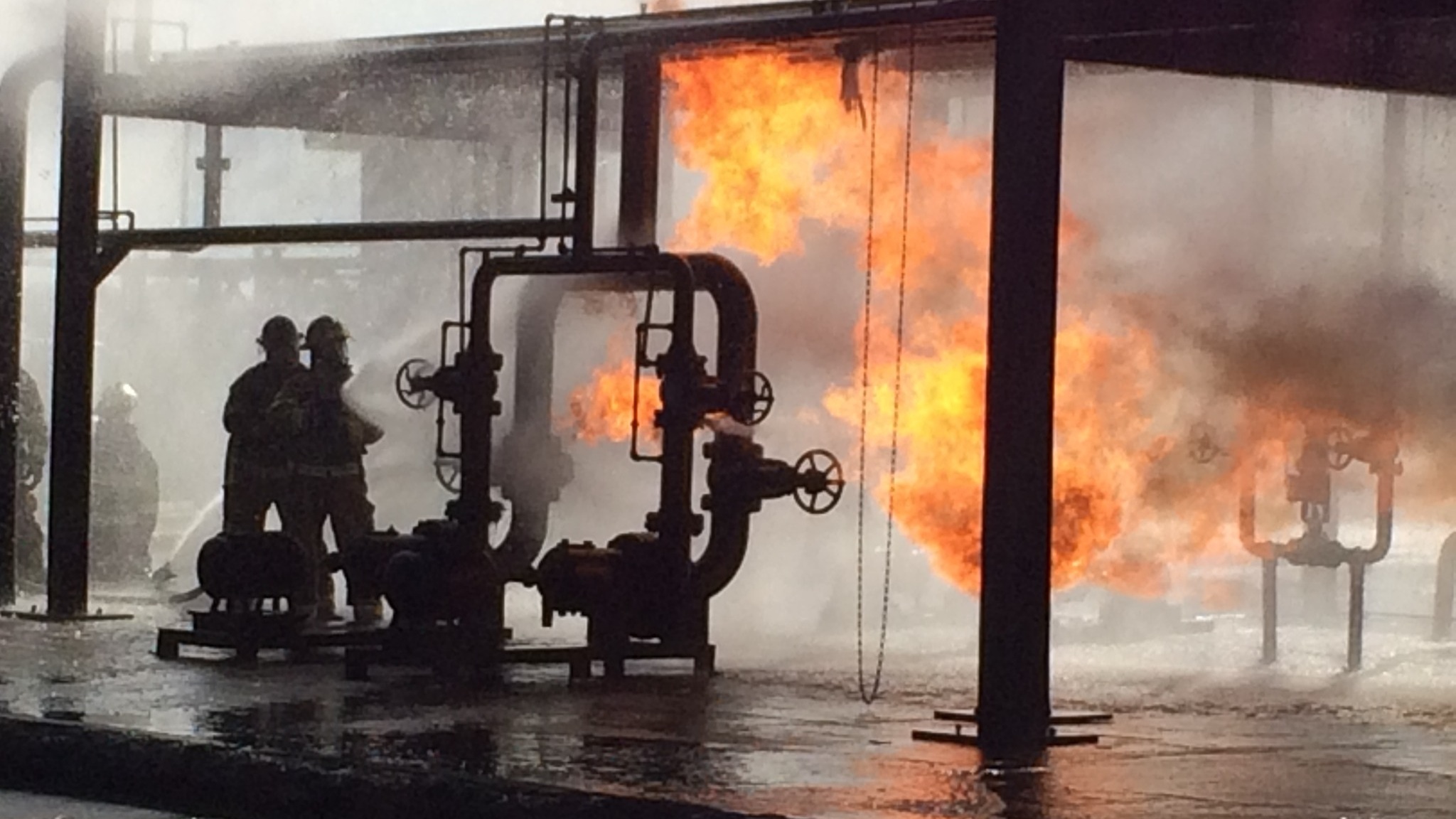
Industrial fire brigades and emergency response teams may need to address flammable liquids and gases, chemical releases, exposure protection, equipment fires, and high-value process areas while supporting life safety and business continuity.
For water-based and foam-based fire protection, that means looking at the complete system, including fire monitors, nozzles, foam equipment, valves, and the water-supply components that support them.
Important: Industrial fire-protection equipment should be selected as part of a site-specific fire-protection and pre-incident planning process. This article is educational and does not replace engineering analysis, applicable codes and standards, insurer requirements, authority-having-jurisdiction requirements, or manufacturer instructions.
Start with the Fire Scenario, Not the Equipment
A common mistake is asking, “How many GPM does this monitor flow?” before answering a more important question:
How much flow does the fire scenario require, and can the facility actually supply it?
A high-capacity monitor does not create water. Its usable performance is limited by the entire system feeding it, including the water source, pumps, piping or hose, valves and appliances, elevation, friction loss, and the nozzle at the discharge.
Before selecting equipment, consider several fundamental questions.
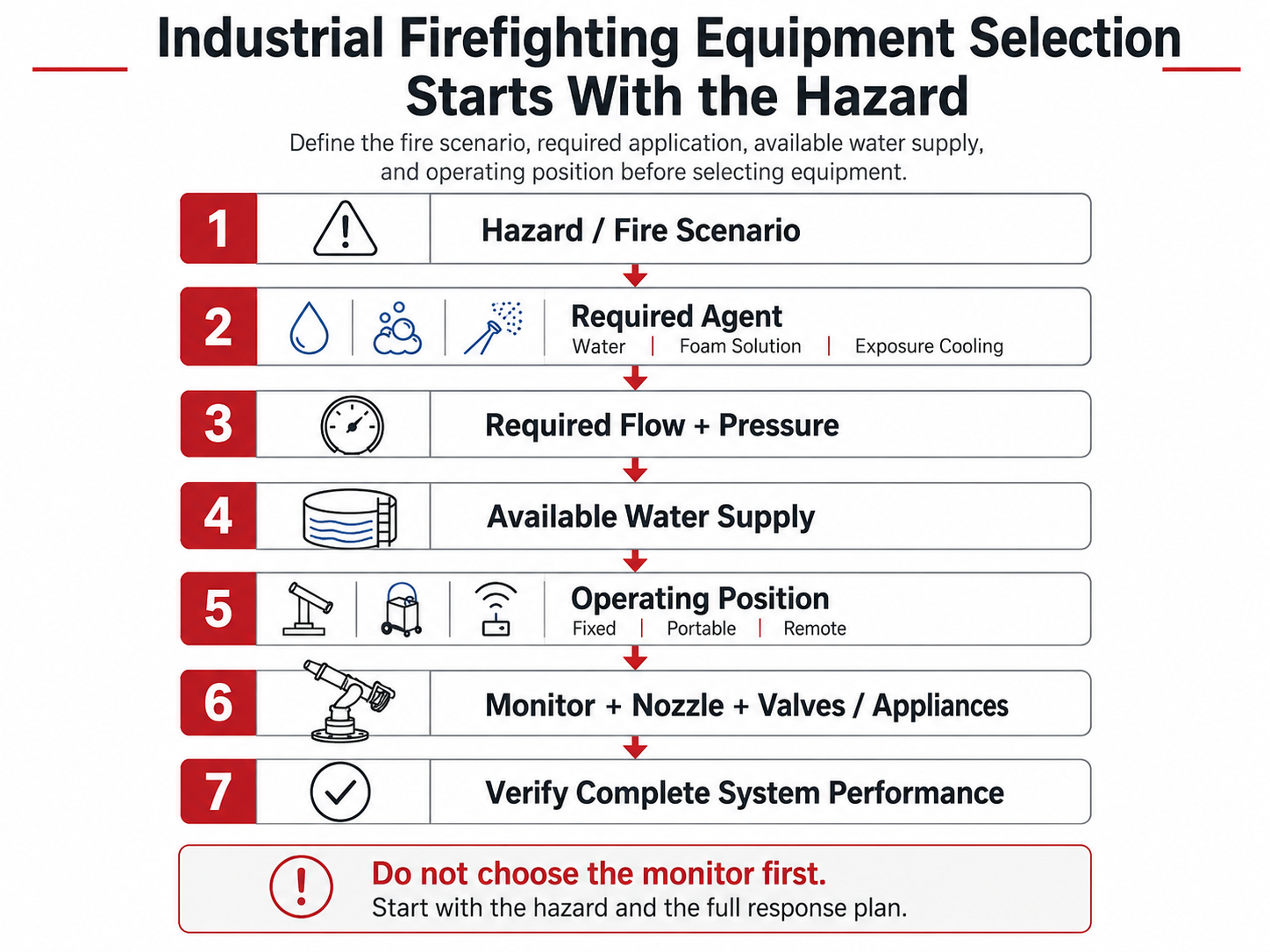
What hazard are you protecting?
The type of hazard affects the extinguishing agent, flow requirements, application method, and equipment configuration.
A facility protecting ordinary combustibles may have very different requirements from one protecting flammable liquids, chemical processing equipment, fuel storage, loading operations, or other high-hazard processes.
What flow is required?
The required fire flow should be established for the hazard and protection objective before selecting the monitor or nozzle.
A monitor rated for a particular maximum flow does not mean that flow is appropriate for every application.
Where will the stream be applied from?
The intended operating position can influence whether a fixed, portable, manually controlled, or remotely controlled monitor is appropriate.
Consider access, potential heat exposure, obstructions, equipment placement, stream reach, and whether operators can safely reach and use the equipment during an incident.
What water supply is actually available?
The available flow and pressure at the water source are only part of the equation.
Pumps, piping, hose, valves, appliances, elevation, and other system losses can reduce the flow and pressure available at the nozzle.
The entire water path needs to support the intended performance.
Is foam part of the response strategy?
Flammable-liquid hazards may require foam as part of the facility’s fire-protection plan.
If foam is involved, equipment selection must account for the foam concentrate, proportioning method, solution flow, application method, aspiration requirements, concentrate supply, and compatibility of the system components.
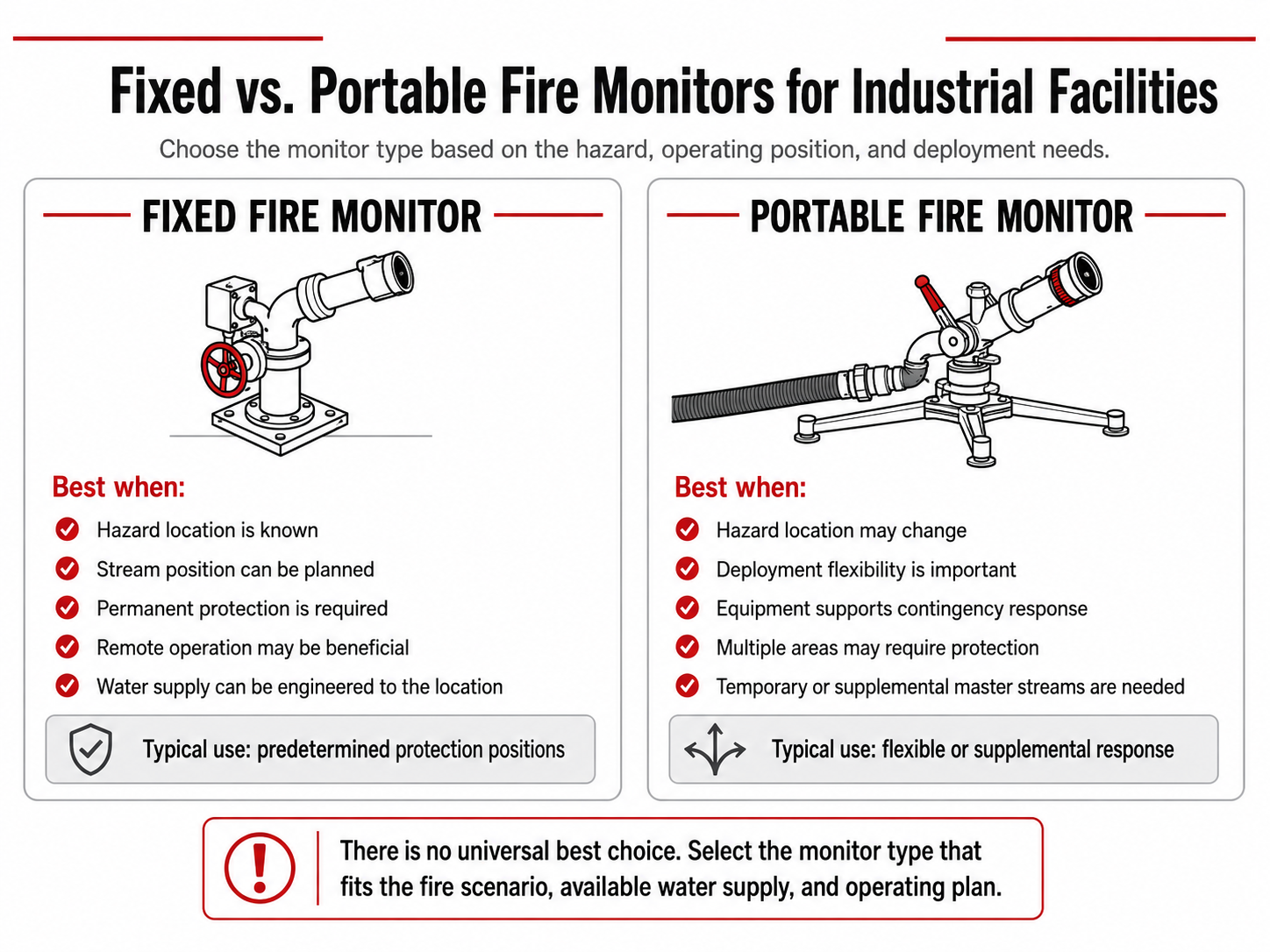
Fixed vs. Portable Fire Monitors for Industrial Facilities
Fire monitors can deliver large volumes of water or foam solution from a controlled position.
Fixed and portable monitors, however, address different operational needs.
When a Fixed Monitor Makes Sense
A fixed monitor is generally suited to a known hazard where the desired stream position can be established in advance.
Applications may include:
- process areas
- tank farms
- loading facilities
- storage areas
- industrial yards
- equipment protection
- exposure protection
- other predetermined fire-attack positions
Fixed monitors can also be configured for remote operation where the response plan calls for operators to remain farther from the hazard.
TFT offers fixed industrial monitor options ranging from manually operated monitors to high-flow remote-controlled systems.
For example, the TFT Protector is a fixed monitor rated for flows up to 1,250 GPM. For significantly higher-flow applications, the TFT Tsunami is available in configurations rated from 4,000 to 8,000 GPM.
The larger flow rating does not automatically make a monitor the better choice.
A high-flow monitor only provides value when the water supply, pumps, piping, nozzle, and fire-protection strategy can support that flow.
When a Portable Fire Monitor Makes Sense
Portable firefighting monitors provide flexibility when the hazard location or operating position cannot be completely predicted.
They can be useful for industrial emergency-response teams that may need to establish or reposition master streams as conditions change.
A portable monitor may be appropriate when:
- the response area covers multiple potential hazards
- a permanent monitor location is not practical
- the equipment will serve as supplemental protection
- crews may need to reposition the stream
- the monitor must be deployed from a vehicle or equipment cache
- temporary operations are part of the emergency plan
The TFT CrossFire can operate as a portable or deck-mounted monitor and is rated for flows up to 1,250 GPM.
For applications where a conventional ground monitor may not be practical, the TFT Hemisphere provides a transportable monitor option that can be mounted in a variety of positions and is rated for flows up to 500 GPM.
The choice between fixed and portable equipment should be driven by the hazard, operating plan, water supply, personnel requirements, and expected deployment conditions.
How to Choose a High-Flow Industrial Firefighting Nozzle
The monitor positions the stream.
The nozzle determines how the water or foam solution leaves the system.
For that reason, the monitor and nozzle should be evaluated together.
Industrial master-stream applications may use several nozzle types.
Smooth Bore Nozzles
Smooth bore nozzles provide a mechanically simple waterway and a solid stream.
Selection should consider:
- tip size
- nozzle pressure
- available flow
- desired stream characteristics
- reach requirements
- water-supply capability
Smooth bore nozzles can be a good fit where simplicity and a defined hydraulic performance point are priorities.
Fixed-Flow Nozzles
Fixed-flow nozzles are designed to deliver a specified flow at a specified pressure.
They can be useful when the fire-water system and response plan are designed around a known operating condition.
Selectable-Flow Nozzles
Selectable-flow nozzles allow operators to choose among defined flow settings.
This can provide flexibility when the required flow may change or when the available water supply varies between operating conditions.
Automatic Nozzles
Automatic nozzles use a variable orifice to help regulate nozzle pressure across a defined operating range.
That does not eliminate the need to understand the water supply.
An automatic nozzle still needs sufficient flow and pressure to operate within its intended performance range.
TFT’s Master Stream nozzle family includes automatic, selectable, fixed-flow, and smooth bore configurations for a wide range of master-stream applications.
The key question is not which nozzle has the largest flow rating.
Which nozzle produces the required stream at the flow and pressure the facility can reliably provide?
Foam Firefighting Requires a Complete System Approach
Flammable-liquid hazards add another level of complexity to equipment selection.
A foam nozzle alone does not create an effective foam system.
The complete application may need to account for:
- fuel or hazard
- foam concentrate
- required concentration
- proportioning method
- solution flow
- application rate
- application method
- aspiration requirements
- water supply
- concentrate supply
- monitor capacity
- nozzle configuration
- system compatibility
Facility-specific foam systems should be designed and evaluated according to the applicable fire-protection standards and the requirements of the foam concentrate and equipment manufacturers.
TFT’s Master Foam series includes self-educting, air-aspirating master-stream options for industrial and flammable-liquid applications.
These products can be part of a larger foam system, but the complete system must be evaluated to confirm that the concentrate, proportioning equipment, nozzle, monitor, water supply, and operating plan work together.
This becomes particularly important when a facility changes foam concentrates or modifies an existing foam system.
Do not assume that equipment that performed as expected with one concentrate will automatically perform the same way with another.
Don’t Overlook Valves and the Water-Supply Path
The nozzle and monitor are the visible parts of a fire stream, but every gallon reaching them has already traveled through the rest of the water system.
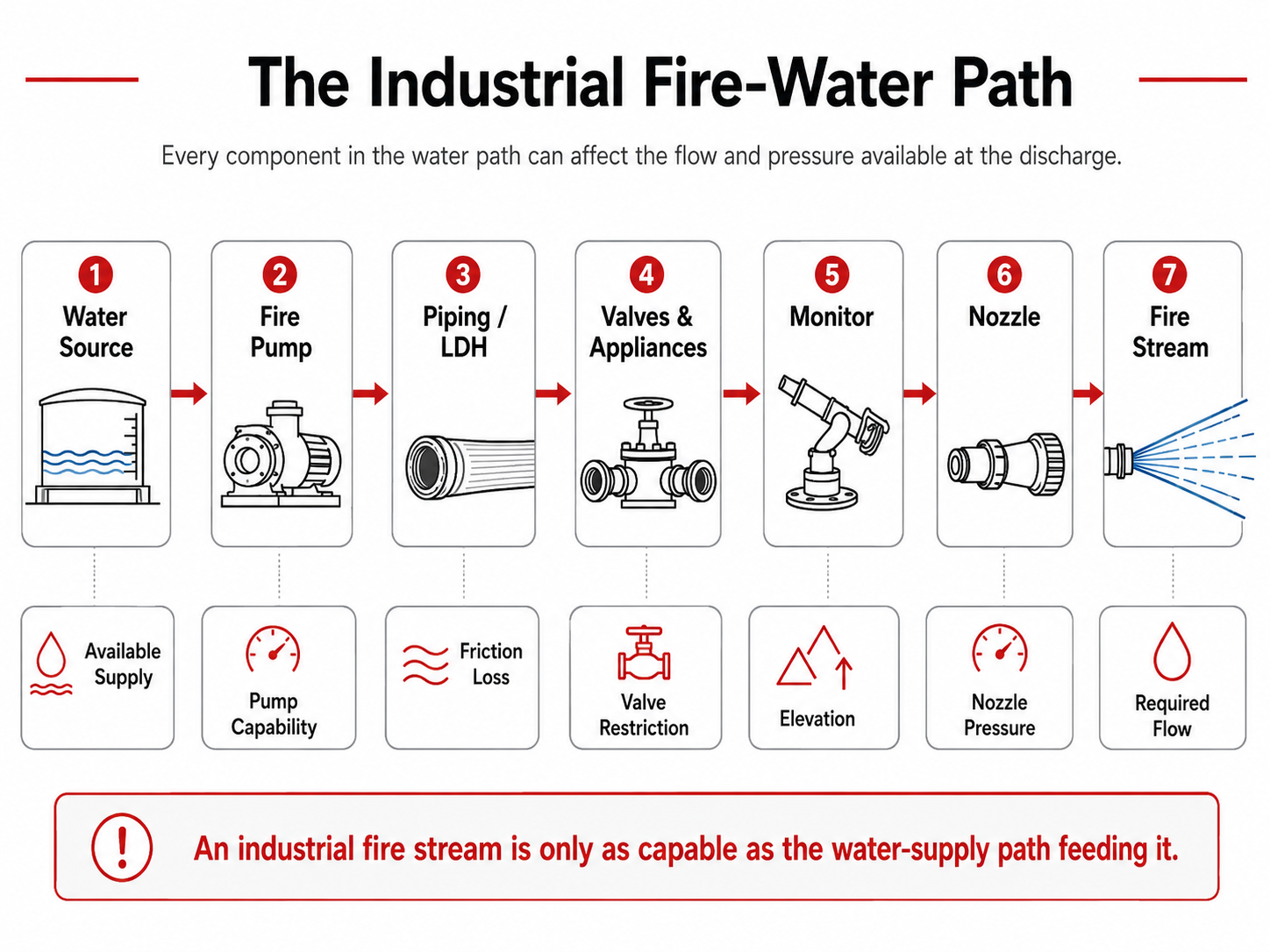
Industrial water-flow systems may include:
- hydrants
- pumps
- fixed piping
- large-diameter hose
- intake connections
- valves
- manifolds
- Siamese connections
- other water-flow appliances
Restrictions and pressure loss upstream can reduce the performance available at the discharge.
When selecting valves and appliances, consider:
- required system flow
- waterway size
- pressure loss
- shutoff and control characteristics
- connection compatibility
- placement and accessibility
- corrosion resistance
- environmental exposure
- drainage
- freeze protection
- inspection and service requirements
The TFT Hydrant Under Monitor, or HUM, is one example of an industrial water-flow appliance designed to combine monitor capability with additional water-distribution functions.
The more important principle is simple:
An industrial fire stream is only as capable as the water-supply system feeding it.
Matching Equipment to the Industrial Firefighting Need
Rather than asking which product is universally best, start by matching the equipment category to the operational problem.
| Industrial firefighting need | Equipment approach to evaluate |
|---|---|
| Predictable fixed hazard or exposure | Fixed monitor and nozzle positioned for the required coverage |
| Need for greater personnel separation | Remote-controlled monitor where appropriate |
| Very high fire-flow requirement | High-capacity fixed monitor supported by a verified water-supply system |
| Changing incident location | Portable firefighting monitor |
| Supplemental master-stream capability | Portable monitor |
| Difficult or unconventional stream position | Transportable or specialized mounting solution |
| Flammable-liquid foam application | Foam-compatible monitor or nozzle with an appropriate proportioning system |
| High-flow water application | Master-stream nozzle matched to the required flow and pressure |
| Industrial hydrant or distribution point | Full-flow valves, manifolds, and appliances sized for the system |
Examples of TFT Equipment for Industrial Applications
TFT offers equipment across a range of industrial water-flow applications.
The following examples illustrate different equipment categories and are not intended as site-specific recommendations.
Tsunami High-Flow Monitor
The TFT Tsunami is a remote-controlled monitor designed for high-flow industrial applications. Available configurations are rated from 4,000 to 8,000 GPM. Applications requiring this level of flow need a water-supply system capable of supporting the monitor and nozzle under actual operating conditions.
Protector Fixed Monitor
The TFT Protector is a manually operated fixed monitor rated for flows up to 1,250 GPM. It can be considered for industrial applications where a fixed master-stream position is appropriate and remote control is not required.
CrossFire Portable Monitor
The TFT CrossFire can operate as either a portable or deck-mounted monitor and is rated for flows up to 1,250 GPM. This provides flexibility for facilities that need portable master-stream capability or multiple deployment options.
Hemisphere Transportable Monitor
The TFT Hemisphere is a transportable monitor rated for flows up to 500 GPM. Its mounting flexibility can make it useful in locations where a conventional portable ground monitor is difficult to position.
Master Stream Nozzles
TFT Master Stream nozzles are available in automatic, selectable, fixed-flow, and smooth bore configurations. The appropriate nozzle depends on the required flow, pressure, stream characteristics, water supply, and operating strategy.
Master Foam Nozzles
TFT Master Foam products provide self-educting, air-aspirating master-stream options for certain foam applications. Any foam application should be evaluated as a complete system rather than selecting the nozzle independently.
Hydrant Under Monitor
The TFT Hydrant Under Monitor, or HUM, combines monitor capability with additional water-distribution connections. It is designed for industrial applications where monitor operation and water distribution need to be integrated at the same location.
10 Questions to Answer Before Buying Industrial Firefighting Equipment
Before specifying a monitor, nozzle, foam appliance, valve, or other water-flow component, the facility should be able to answer these questions:
- What specific fire or exposure scenario is this equipment intended to address?
- What extinguishing agent and application method does that scenario require?
- What flow and pressure are required at the discharge?
- Can the existing water supply sustain that requirement after accounting for system losses?
- Where will firefighters or brigade members operate during the incident?
- Should the monitor be fixed, portable, manually controlled, or remotely controlled?
- What nozzle and stream characteristics are required?
- If foam is involved, have concentrate, proportioning, application, and equipment compatibility been verified?
- How will the equipment be inspected, tested, maintained, and supported throughout its service life?
- Can the proposed system be demonstrated or flow-tested under conditions representative of the facility?
These questions help move the equipment discussion from individual product specifications to the performance of the complete firefighting system.
The Best Industrial Firefighting Equipment Starts With the Right Requirements
Industrial fire protection is not a contest to find the monitor with the highest GPM rating.
The goal is to build a firefighting capability that matches the hazard.
Start with the fire scenario.
Determine the required extinguishing agent and application method.
Establish the required flow and pressure.
Verify the available water supply.
Account for system losses.
Determine where and how the equipment will be operated.
Then select the monitor, nozzle, foam equipment, valves, and other components capable of delivering the required performance.
The best industrial firefighting equipment is not necessarily the largest or highest-flow option.
It is the equipment that fits the facility’s fire-protection plan, integrates with the available water system, can be operated effectively by the response team, and performs as expected when it is needed.
Evaluating an industrial firefighting water-flow application? Task Force Tips can help review monitor, nozzle, foam, valve, and water-flow equipment options for your operating requirements.