

Understanding Nozzle Reaction: A Guide for Firefighters
What is nozzle reaction, and why does it matter?
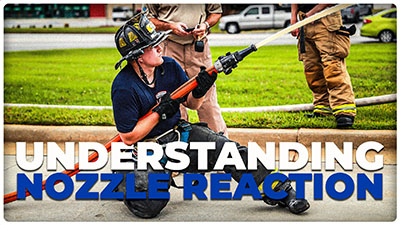
Nozzle reaction is the force that pushes back against a firefighter operating a hose line. It’s caused by the pressure and flow of water leaving the nozzle. The stronger the reaction, the harder it is to control your stream, stay mobile, and minimize fatigue. Understanding this force helps you make better nozzle choices, operate more effectively, and reduce risk on the fireground.
Why Should You Care About Nozzle Reaction?
If you’re fighting the nozzle instead of the fire, your performance suffers. Nozzle reaction affects:
• Mobility during interior or hallway advances
• Fatigue over long fireground operations
• Muscle strain and injury risk
• Crew coordination during line movement
Every pound of nozzle reaction adds resistance. Managing it well means more precise streams, faster line movement, and less burnout.
How Is Nozzle Reaction Created?
Nozzle reaction is a product of physics. As water accelerates through a nozzle, pressure and velocity build. The “reaction” to that force is what pushes backward on the nozzle operator.
Key contributors:
• Flow rate (GPM) – Higher flow = higher reaction
• Nozzle pressure (PSI) – Higher pressure = higher velocity = higher reaction
• Nozzle type – Smooth bore vs. fog vs. automatic nozzles behave differently
See Hydraulic Calculations for Firefighting →
How Does Nozzle Type Impact Nozzle Reaction?
Smooth Bore Nozzles:
• Reaction is based on actual exit pressure.
• Use the formula: NR = 1.57 × D² × NP
• D = Nozzle diameter (inches), NP = Exit pressure (PSI)
Fog/Combination Nozzles:
• Reaction is calculated from inlet pressure, which may overestimate reaction.
• Formula: NR = 0.0505 × GPM × √NP
• GPM = Flow rate, NP = Inlet pressure (PSI)
Automatic Nozzles:
• Regulate pressure automatically.
• Reaction increases with flow, but not as sharply with pressure.
Visit the Hydraulic Calculations Page →
Common Misconceptions About Nozzle Reaction
1. The formula always gives you the exact answer.
Not quite. Especially with fog nozzles, friction loss isn’t factored in, so calculated reaction can be higher than actual reaction.
2. Lower nozzle reaction is always better.
Not always. Reducing reaction often means reducing pressure, which can soften the line. Softer lines kink more easily and reduce maneuverability. It’s about finding the right balance.
Read: Understanding Your K-Factor
FAQs: Firefighter Nozzle Reaction
Q: What’s the ideal nozzle reaction for one firefighter?
A: 70 lbs or less is typically manageable by a single firefighter.
Q: Do automatic nozzles reduce nozzle reaction?
A: They regulate pressure, which can reduce perceived kickback, but total reaction still scales with flow.
Q: Does fog vs. smooth bore affect nozzle reaction?
A: Yes—fog nozzles tend to feel “softer,” but calculations can overestimate their reaction due to pressure assumptions.
Q: Is nozzle reaction worse on 2½″ lines?
A: Yes—higher flows increase reaction. Proper staffing and coordination are critical.
Key Takeaways
• Nozzle reaction is unavoidable—but manageable.
• Understand your nozzle, your flow, and your line pressure.
• Avoid reaction myths that cause you to underperform.
• Use training and equipment choices to stay in control.
Tell us what you thought about this article!
Latest Comments
Thanks for your perspective! What kinds of building construction do you typically face in your response district?
Thanks for the regional insight, Alex! Super interesting. So you’re going smooth bore 100% – do you prefer a handline…
That first blitz nozzle isn’t made anymore? And dosnt have the s Auto shut off protection. I had both. Yea…
Good stuff. BUT “You’ll need to start a tank transfer when the initial tank is near capacity, and tankers continue…
Wow! Thank you for sharing that, that’s our No. 1 goal – to help real firefighters solve real problems. If…
Burp Drafting was a great eye opener & multiple intake drafting had to be a great lesson. We had a…
That’s great to hear, sir! That makes us happy. What was your favorite thing you learned?
We had the pleasure of having the Water Thieves Training in McCurtain County, Oklahoma March 8 & 9th. Great Training…
Most garages in Florida are used as storage areas. In fact a lot of people are hoarders and the garage…
Thanks for watching, Tom!
Wow, another tool in the chest. Very easy to follow.
Absolutely! Thank you for the interest and thank you for watching! Here is a link to our X account. https://x.com/taskforcetips
Hi there! Do yоu use Twitter? I’d lіke to follow you if that wouⅼd be ok. I’m definitеly enjoying your…