

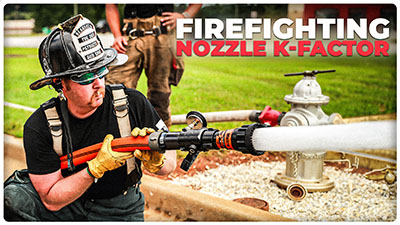
Understanding the K-Factor of Your Nozzle
As familiar as the subject of water flow may be to some, there are still those that do not have the opportunity to apply it daily. As a result, they may not be as familiar with water flow as those of us who do.
One comment that I often hear is that fixed and selectable gallonage nozzles are limited to the rating or setting. This is far from true. Any fixed or selectable gallonage nozzle can be under or over-pumped depending on what the desired outcome is.
Now, obviously you would not want to go to extremes and generate too much nozzle reaction or have too low of a pressure, but there is some wiggle room for deviation from actual flow and pressure ratings.
Let’s explore this concept a little further.
What is a Nozzle’s K-Factor or K-Value?
The flow rating on a fixed or selectable gallonage nozzle is simply how much flow it will deliver at that base nozzle pressure. This flow rating is a minimum, but not to exceed 10% above the flow rating at the rated base nozzle pressure..
For example, a 150 GPM nozzle can flow anywhere between 150 GPM and 165 GPM at its rated base pressure and be compliant with the NFPA (National Fire Protection Association) 1964 standard. You can figure this out by finding 10% of your nozzle’s flow rating and adding that value to the flow rating. So, for a 150 GPM nozzle:
- 10% of 150 = 15
- 150 + 15 = 165
The flow and pressure rating are indicated by what is known as a K-factor or K-value. This value can determine flow at any given pressure or vice versa, pressure at any given flow. This information is illustrated on the flow curve found in the technical support materials for your nozzle.
Finding the K-Factor of Your Nozzle
Finding the K-Factor of your nozzle is quite easy. You can use the following formula:
K = flow/√NP
In this equation, NP stands for nozzle pressure.
Let’s work through an example with a 150 at 50 nozzle.
- K = 150/√50
- K = 150/7.07
- K = 21.21
Now, you can take the K-value of 21.21 and multiply it by the square root of 75 (representing a nozzle pressure of 75). 21.21 * 8.66 = 184 GPM. We get this value by working the formula to solve for flow instead of the K-value.
- K = flow/ √NP
- 21.21 = flow/ √75
- 21.21 = flow/8.66
- Flow = 21.21 * 8.66
- Flow = 184
What this shows is that a 150 at 50 nozzle and a 185 at 75 nozzle are essentially the same give or take a few GPM and PSI. If you work the formula for them, you will also find that a 160 at 50 and 200 at 75 nozzle are essentially the same.
K-Value in the Real World
Understanding the K-value can help you develop discharge pressures for various flows based on the conditions you face. If two 150 GPM handlines is your standard, you can easily deliver at an almost 25% higher application rate if needed by understanding what your nozzles are capable of and figuring out the required pump discharge pressure for the additional flow and nozzle pressure.
Keep in mind that over pumping any given nozzle will increase your nozzle reaction. You and your crew should be mindful of this as it increases strain on the firefighter at the nozzle and can increase the risk of injury.
Wondering how to choose the right nozzle for your crew? Read more about the nozzle selection process in this article!
Tell us what you thought about this article!
Latest Comments
Thanks for your perspective! What kinds of building construction do you typically face in your response district?
Thanks for the regional insight, Alex! Super interesting. So you’re going smooth bore 100% – do you prefer a handline…
That first blitz nozzle isn’t made anymore? And dosnt have the s Auto shut off protection. I had both. Yea…
Good stuff. BUT “You’ll need to start a tank transfer when the initial tank is near capacity, and tankers continue…
Wow! Thank you for sharing that, that’s our No. 1 goal – to help real firefighters solve real problems. If…
Burp Drafting was a great eye opener & multiple intake drafting had to be a great lesson. We had a…
That’s great to hear, sir! That makes us happy. What was your favorite thing you learned?
We had the pleasure of having the Water Thieves Training in McCurtain County, Oklahoma March 8 & 9th. Great Training…
Most garages in Florida are used as storage areas. In fact a lot of people are hoarders and the garage…
Thanks for watching, Tom!
Wow, another tool in the chest. Very easy to follow.
Absolutely! Thank you for the interest and thank you for watching! Here is a link to our X account. https://x.com/taskforcetips
Hi there! Do yоu use Twitter? I’d lіke to follow you if that wouⅼd be ok. I’m definitеly enjoying your…