00:00:00:04 – 00:00:11:04
Sean Gray
That’s, we have been brainwashed with that over the years, is that, you know, more GPMs, more BTUs, more GPMs, big fire, big water. We’ve heard all these things over the years, and it’s just simply not true.
00:00:11:07 – 00:00:17:08
Gordon Voit
It’s respectful, and he disagrees with you. Okay. And I’m really curious to hear your response. Could I just have you.
00:00:17:09 – 00:00:17:13
Sean Gray
Sure.
00:00:17:15 – 00:00:19:05
Gordon Voit
Of course, you have not read this before.
00:00:19:06 – 00:00:20:16
Sean Gray
Have not. Nope.
00:00:20:18 – 00:00:28:00
Narrator
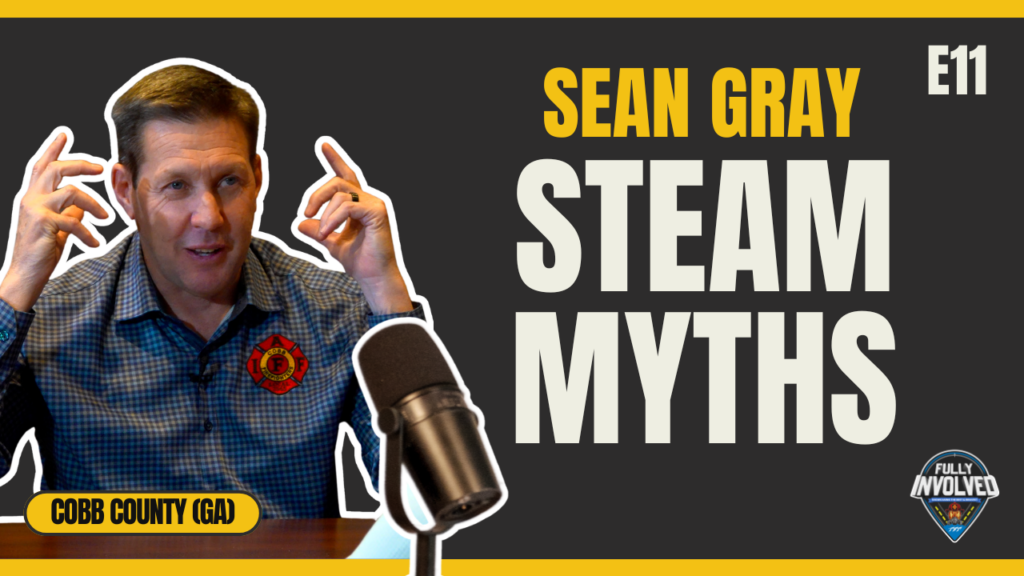
One of the most popular guys at FDIC is back for another podcast episode. It’s Cobb County, Georgia’s Sean Gray.
00:00:28:00 – 00:00:36:14
Narrator
In this episode, we talk about the viral response to his fully involved episodes, and he’s even going to answer some criticism live.
00:00:36:19 – 00:00:39:17
Narrator
We talked about gas cooling versus surface cooling,
00:00:39:19 – 00:00:48:14
Narrator
a common basement fire mistake that he sees, and the changes to search research in the brand-new edition of his book, Evolving Fire Ground.
00:00:48:16 – 00:00:56:20
Narrator
Join us at the Connecticut Fire Academy’s Winter Fire School, and get ready for 30 minutes of knowledge to help you level up your game.
00:00:56:20 – 00:01:04:18
Must be coming in.
00:01:04:20 – 00:01:07:11
Gordon Voit
Back by popular demand. Great.
00:01:07:12 – 00:01:08:13
Sean Gray
Yeah. Thank you for having me.
00:01:08:14 – 00:01:24:20
Gordon Voit
Thank you so much. You hosted us in Cobb County. Yep. We did an interview, and people love it. They love to hear what you have to say. So we’re here at Connecticut Fire Academy’s Winter School with the keynote speaker himself, Sean Gray. Thank you so much for joining us.
00:01:25:00 – 00:01:27:00
Sean Gray
Thank you for having me, man. Always a pleasure.
00:01:27:03 – 00:01:35:07
Gordon Voit
So I got to know, what’s it been like watching the responses on social media to our tactical videos and your podcast interview?
00:01:35:07 – 00:01:54:09
Sean Gray
Well, you know, I was a little nervous because of our past social media experiences that we’ve had with Stop Believing, Start Knowing. And so I was like, oh, man, here come all the haters, right? So, but no, it’s been nothing but positive. It’s been great to see, and, you know, really glad that you guys have had a lot of people kind of lock onto them and be paying attention and listen to what’s being said.
00:01:54:10 – 00:02:07:09
Sean Gray
And of course, I’ve taken some ribbing personally, that kind of thing. You know, when I’m up there and, you know, my face is up there, I’m like, you know, people make fun of me like, oh, great, my social media feed’s going to blow up again with Sean Gray’s face on it. But yeah. So it’s all been good.
00:02:07:10 – 00:02:11:14
Gordon Voit
Yeah. Like, who has reached out to you? What’s the response been like from your friends?
00:02:11:15 – 00:02:28:12
Sean Gray
Honestly, nothing but positive. You know, everybody’s like, hey, man, that last video you guys did, that was great. You know, really love it. Just good conversations. And so it’s kind of hard to beat it up when it’s all, you know, research-based and very factual. So it’s not like it’s just BS and it’s just my opinion type of thing. You know.
00:02:28:13 – 00:02:29:02
Sean Gray
You know.
00:02:29:08 – 00:02:40:03
Gordon Voit
What was the tactic or the video we did that touched a nerve the most, where you were like, whoa, that really got a strong reaction?
00:02:40:05 – 00:03:03:02
Sean Gray
You know, probably, I think that people are really locking into the VEIS type stuff now. And so when we did that window-initiated search and the guys were talking about like, you’re going in a window, you have hot gas coming out over top of you. It’s okay to flow water in that window. I think that’s still, people are a little nervous about that, about putting water that close to firefighters.
00:03:03:04 – 00:03:15:09
Sean Gray
And so that’s one of those things where people are still probably not comfortable with that, because they still think that they’re going to get steamed and burned. And that’s just simply not the truth. It’s only cooling that room off, and it’s only making things better.
00:03:15:10 – 00:03:29:02
Gordon Voit
So I’m glad you brought that up, because there was actually a comment that came in. One of the many comments you’ve gotten. This was very recently, and it’s respectful, and he disagrees with you. Okay. And I’m really curious to hear your response. Could I just have you.
00:03:29:03 – 00:03:29:07
Sean Gray
Sure.
00:03:29:09 – 00:03:30:23
Gordon Voit
Of course, you have not read this before.
00:03:31:00 – 00:03:32:09
Sean Gray
Have not. Nope.
00:03:32:11 – 00:03:47:23
Gordon Voit
Awesome. This is of your comment there. Okay. You don’t necessarily have to read it aloud, but just, yeah. What’s the gist of his question from what you can tell? And take your time kind of digesting it. He’s never seen this before.
00:03:48:00 – 00:03:49:05
Sean Gray
Yep.
00:03:49:07 – 00:03:50:05
Gordon Voit
It’s Captain Brain.
00:03:50:05 – 00:03:58:08
Sean Gray
That’s pretty funny that I just brought that up about the, that I just brought that up about steam, because I had no idea that this was going to be on here.
00:03:58:10 – 00:04:00:07
Gordon Voit
Yeah. So, so what’s his objection?
00:04:00:09 – 00:04:33:00
Sean Gray
Yeah. So he, you know, he said, you know, what’s been disproven is oversimplified teaching. The water automatically expands to 1,700 and violently displaces everything in the compartment. Steam formation itself was never disproven. Well, technically, in the UL FSRI fire attack study, we actually learned we had some kids that are just amazing. They built lasers that went across the middle of the hallway. And yeah, so, and so that was really trying to figure out exactly how much moisture was in a fire before we even put water into it.
00:04:33:01 – 00:04:51:10
Sean Gray
Right. And so what we learned was the moisture content just from what’s burning inside of the fire is actually very, very high. And so, yeah, it’s a really wet environment. And it’s mostly just because if you ever take like a piece of foam and you’re just playing with it, you start lighting foam, it actually starts dripping water out of it, fire and dripping.
00:04:51:10 – 00:05:13:10
Sean Gray
So you’re like, wait a minute. What? That doesn’t make sense to me. So yeah. So there’s been a thing that’s been in the books forever about the 1,700 times. And that 1,700 times is just simply inaccurate. It came from locomotive steam engines, and it was hypothetical, and somehow made it into our textbooks. And firefighters have that number in their head of 1,700 times.
00:05:13:10 – 00:05:36:04
Sean Gray
It’s going to expand that no matter what. It’s been there for, I don’t even know how many years, longer than I’ve been in the fire service. It’s been there. So, and people still believe that. And then they have these experiences, bad experiences that happened on a fire ground. Stories get told at the kitchen table. And those stories continue on, right, in the firehouse.
00:05:36:05 – 00:05:59:10
Sean Gray
And so, clearly, this person has had a bad reaction at some point in time, and maybe even from an exterior stream. And so, usually when I run into people that have concerns like this about exterior water, I ask them what type of stream were they using? And usually, they can’t tell you. It’s like, I don’t know, I was inside, and it was hot.
00:05:59:10 – 00:06:21:18
Sean Gray
And then they brought water in, and things got really hot. But it’s always amazing. Their ears are never burned off, and it’s not like they have, you know, scars on their ears or anything like that. But it probably was uncomfortable for just a second if a misapplied exterior stream was put on there. So when I say misapplied is, you know, we talk about the right way to do that. It’s got to be on a straight stream, you know.
00:06:21:19 – 00:06:41:16
Sean Gray
And if I can advocate, I want you guys to make a nozzle that locks in place on a straight stream. And then we can unlock it by pressing a tab, going to fog, because we want it to be locked in on a straight stream. If it’s on a fog stream at all, if somebody makes a mistake when they put a fog stream into there, the fog, because of the air and the convective air that’s coming with it.
00:06:41:16 – 00:07:04:03
Sean Gray
That’s why it’s so important to understand air entrainment, that air that’s coming in there with the smaller droplets. It could absolutely start to expand some gases inside of there, and there could be some pushing, right, pushing of gases, not really necessarily pushing fire, because water droplets put out fire. But you’re going to push hot gases with the air of that nozzle, not necessarily with the water of the nozzle, but with the air of the nozzle.
00:07:04:03 – 00:07:16:01
Sean Gray
And that’s super important to understand. That’s why we really want to keep things on straight streams, either smooth bore or straight streams. It’s got to be locked-in tight streams when we’re fighting fire, especially on exterior fire control.
00:07:16:03 – 00:07:16:20
Gordon Voit
Interesting.
00:07:16:21 – 00:07:19:00
Sean Gray
I hope I answered all of it. I didn’t read the whole.
00:07:19:00 – 00:07:33:13
Gordon Voit
Thing, but it is a very long comment. Okay. Yeah, he says if we’re going to promote aggressive research and informed fire funding, it’s important to present the facts completely and precisely, not selectively. And you’re basically saying, well, you know, what’s the accuracy of.
00:07:33:13 – 00:07:56:03
Sean Gray
Sure. It’s difficult. I mean, these reports are 1,000 pages long. You know, it’s very difficult in a two-minute video to actually be able to put all of the facts in there. So I understand his concerns in his comments, but I would challenge him to go back and pull up the report and where it talks about the moisture content of what was burning and exactly what comes out of the live fire environments.
00:07:56:03 – 00:08:04:10
Gordon Voit
Interesting. Yeah, I think this is a nice segue into, would love to hear about your trip to Wales. What were you tackling in Wales?
00:08:04:11 – 00:08:08:13
Sean Gray
Yeah. So the UK fire service in general, just
00:08:08:17 – 00:08:27:03
Sean Gray
they’re transitioning, and they’re transitioning the type of nozzles that they’re using. So they have traditionally always used gas cooling as their primary fire attack method. And so that is a high-pressure hose line, 22 mm hose line, which for us here in the U.S. is tiny, 0.87 inches.
00:08:27:03 – 00:08:53:14
Sean Gray
Yeah, smaller than a one-inch line. And it flows, you know, very little water, somewhere in the 50 to 60 gallon range type of thing. So, and with a nozzle and with that high pressure, they traditionally have some door control tactics. When they get there, I should say just door tactics. And they put water up into the gases to try to convert the gases to steam with that smaller droplet.
00:08:53:16 – 00:09:16:07
Sean Gray
If you start to understand the methodology behind that, they think hypothetically that it’s a 0.33 mm size droplet, right, in order to convert the gases over, which is tiny. For us in the U.S., the easiest way to explain is like fighting fire with with a pressure washer, you know. So if I, yeah. So if I were to tell you as firefighters, say you want to fight fire with a pressure washer, they’re like, heck no, I don’t want to fight fire with a pressure washer.
00:09:16:07 – 00:09:37:17
Sean Gray
So, but for them, they are really good at controlling the air on their fires. So they’re really, really hardcore. Like, they don’t take any windows. There’s very little venting. They control all the doors. So they really take the air away from the fire, which allows them to have lesser GPM nozzles to be able to go in and do gas cooling.
00:09:37:17 – 00:10:00:13
Sean Gray
So, but they are transitioning. They’ve had some, they’ve had, they are following the research. They know where all the research is coming from. They talk about exactly that, it doesn’t take as much water as we think that it does, and then about surface cooling. So I went there to, they are building the FSRI water mapping props. They’re building them all over the place in the UK, which is pretty cool to see.
00:10:00:13 – 00:10:19:03
Sean Gray
And so I went there because they had built an FSRI water mapping prop, and they wanted somebody to come over and do a train the trainer and talk about surface cooling. And so, yeah, so I got to go over there and kind of represent the U.S. and speak in Wales. But yeah, super cool. You know, really, really good people.
00:10:19:05 – 00:10:40:14
Sean Gray
They were even like almost a little nervous to get on an inch-and-three-quarter hose line because that is their like defensive line almost. That’s their hose line that they use. Like what we typically use two-and-a-half. Like, a lot of people, one person on a two-and-a-half typically is not going to get down there and be super happy that they’re on a two-and-a-half by themselves, right?
00:10:40:15 – 00:10:58:17
Sean Gray
It’s just such a big line, a lot of water coming out of it. That’s how they feel about the 44 millimeter, which is equal to our inch-and-three-quarters. And so, yeah, so it was kind of fun to see that and then teach them some nozzle techniques and then talk about surface cooling with them and painting rainbows going down hallways and, you know, that kind of stuff.
00:10:58:17 – 00:11:22:07
Sean Gray
Gas cooling versus surface cooling. So, you know, historically, the European fire service has always done gas cooling. And, you know, they’re wanting to go to surface cooling, which is all the nozzles that TFT makes. Right. So with surface cooling and gas cooling. So in America, our water droplets are too large to do gas cooling.
00:11:22:08 – 00:11:40:21
Sean Gray
I think people have taught, almost maybe even bastardized. So Americans went over to Europe, and they said, hey, this gas cooling thing is pretty cool. It’s very scientific. And so, I’m going to bring that back. And so they brought it back to the U.S. and developed techniques and went back to their own departments. Matter of fact, L.A. County did this before the fire attack study.
00:11:40:21 – 00:11:46:02
Sean Gray
And then they learned in the fire attack study that, hey, what you guys are doing actually doesn’t work at all. It’s completely made up, right?
00:11:46:03 – 00:11:46:20
Gordon Voit
Because it’s.
00:11:47:01 – 00:12:09:13
Sean Gray
Because of the droplet size. So our droplets here in the U.S., our nozzles, we have larger droplets. The energy of the fire gets eaten up by those larger droplets. Versus in Europe, they have very small droplets, and they try to put that small droplets up into the gas layer to do gas cooling. So that gas cooling has to be 0.33 mm in size.
00:12:09:14 – 00:12:38:02
Sean Gray
Okay. So this hypothetical, but about that water droplet size. And so it’s like a pressure washer, that small, right. So they are trying to cool gases. But the same thing is their nozzles aren’t making it through the gases with that fog onto the surfaces. So they’re not really doing any surface cooling. And one of the things that we’ve learned from research is that the surfaces are very, very important because you can get rebound ignition of gases just based off of the surface temperatures.
00:12:38:02 – 00:12:58:16
Sean Gray
So it’s important for us to coat the surfaces with water. That’s why I talk about painting rainbows down a hallway. Right. Because we’re going to coat that entire surface all the way down that hallway. And when we make it down the hallway to the very end, we want to try to put the water up, up steep, across the ceiling surfaces into the fire room and allow it to come down onto the wall.
00:12:58:16 – 00:13:20:02
Sean Gray
So we cool all the surfaces before we put water onto the burning fuels. Right? So let’s understand really like a sprinkler. But the, yeah, the sprinkler’s just not coming out. It’s really, it’s actually the velocity of the stream is allowing, is taking the water and it’s pushing it across the surfaces. And so it surfs, the water actually surfs right across the surfaces and makes it down there.
00:13:20:02 – 00:13:35:22
Sean Gray
And so you can coat everything. That’s why the water mapping rig is so important. Because when you see that water mapping prop, it’s because of the clear glass that we use in the hallway, as the students can stand there and see it, and they just watch the surfaces. What’s amazing is that you don’t actually have to use your nozzle.
00:13:35:22 – 00:13:53:16
Sean Gray
You don’t actually have to move it that much. If you just go to the very end of the hallway and you put the nozzle straight up, that water is going to surf right across that ceiling, and it’s going to go all the way down. It comes right down the walls. And so you can show students that, hey, stream angle matters.
00:13:53:18 – 00:14:15:11
Sean Gray
The movement of the nozzle matters to coat all the surfaces. And so you’re able to take, in that actual prop, just really show people the advantage of surface cooling. And that’s where, in Europe, that’s why they’re starting to transition. They’re transitioning to the newer nozzles and really starting to make a change. And I love their lower GPM stuff.
00:14:15:12 – 00:14:32:07
Sean Gray
I think that that’s a huge thing. They use liters per minute. But I think that we should meet somewhere in the middle. I think the U.S. and Europe are, we’re getting really close. So ever since my time over there in Wales, I’ve had some guys from Europe reach out on social media, and we’ve had some discussions back and forth, and they agree.
00:14:32:08 – 00:14:50:02
Sean Gray
I was like, I think we’re too far. We’re flowing too much water. Right? So our water requirements are too high, and I’d love to see it come back and get dialed in maybe around the 125, 130 GPM range. And this is just all hypothetical. It’s just Sean Gray’s opinion here. I have no research to back this up.
00:14:50:02 – 00:15:02:23
Sean Gray
Right. But, and then they need to probably come up from their smaller hose line, reel hose lines, high-pressure lines, and meet us somewhere in the middle right around that. So, you know, I think we’re getting there. Yep.
00:15:02:23 – 00:15:11:04
Gordon Voit
So, yeah, that’s so cool. And then so is your picture like on banners all over Wales? No. No parade.
00:15:11:06 – 00:15:28:16
Sean Gray
No, not so, yeah. No, it’s pretty funny, but they were lovely hosts. I mean, they were awesome, you know. Of course, took me out to the pub and took me out to, as they would say, a proper pub. And so I went to a proper Welsh pub and went to a, there’s a castle right outside the pub that they took me to.
00:15:28:17 – 00:15:44:09
Sean Gray
And yeah, of course, like everybody has a castle right there, they’re downtown, so like huge, you know, old castle. And then right into going to this pub, and there were people just in there with fiddles, just playing music. Like, they were all a little confused too. Like, this doesn’t normally happen. It wasn’t like live music that was planned to be there.
00:15:44:09 – 00:15:52:20
Sean Gray
It was just some patrons that had come in and brought in their fiddles. And there they were, playing this very Celtic music, and it was awesome. Oh, yeah. Great. Yeah, a very good experience.
00:15:52:22 – 00:15:59:11
Sean Gray
And so this training was to create a train the trainer group for them to be able to go out and train the Wales fire service.
00:15:59:11 – 00:16:08:10
Gordon Voit
Wow. That’s got to feel pretty cool. The fact that your impact wasn’t just with that group and knowing that you’re going to make an impact for the whole country, potentially.
00:16:08:11 – 00:16:12:16
Sean Gray
Yeah. No. Yes, pretty cool. Yeah. Not a very big country, but yeah, pretty small place.
00:16:12:16 – 00:16:14:01
Gordon Voit
But
00:16:14:03 – 00:16:29:07
Gordon Voit
what are the other tactics that, when we were kind of deciding what to chat about, basements. Tell me about what low intake and high exhaust. Why is this something that you feel like is misunderstood?
00:16:29:09 – 00:16:56:19
Sean Gray
Yeah. So if you really look at some historical line-of-duty deaths, we’ve had a lot of low intake, high exhaust. And historically, going back to talk about Cherry Road in D.C., Diamond Heights fire in San Francisco, [unclear] Avenue, and most recently in FDNY, there’s been a lot of fires that have, or people don’t recognize that the fire is below them, and they’re caught in an exhaust above them.
00:16:56:19 – 00:17:18:03
Sean Gray
So low intake, meaning that the air is being pulled in on the lower level, and the firefighters are operating on the upper level. And it’s an exhaust. So they are caught in that flow path. That’s a very dangerous place for both civilians and for firefighters. So low intake, high exhaust, yeah, it can happen in a basement. I think that’s what most people think of when they think of low intake, high exhaust.
00:17:18:03 – 00:17:38:09
Sean Gray
But it really can happen, you could be on a ten-floor building. It could happen in a stairwell from the ninth floor to the 10th floor. Right. It’s low. It’s got to be just below it, like you’re just operating above it. So dangerous place to be, really recognized. And I encourage people to go onto the FSRI Fire Safety Academy.
00:17:38:13 – 00:17:57:19
Sean Gray
They have, it’s like a two-minute video that was put together about low intake, high exhaust, and really try to familiarize yourself with that. But how do you fight that fire? You try not to commit above it if you can. You know, got to get water on the same level that the fire is on. And so some people are going to say, well, you know, how do I go?
00:17:57:22 – 00:18:22:15
Sean Gray
What do I go down into? How am I going to, I have to go down the stairs. That’s the only access point typically in basements or anything like that. There’s very few places that don’t have a door that accesses a basement, windows that access the basement. There’s typically some sort of opening. There are dwellings that have just a solid block, just the stairwell going down in there.
00:18:22:16 – 00:18:41:07
Sean Gray
You know, that’s kind of that creepy thing that you see in the horror movies, right? That. Right. So there’s just like a boiler or something like that downstairs. Right? Yeah, that does happen. But you know what the advantage of that is, is in fires that are down below that, and that you would have to go down because we’re taught in the academy to be able to go down, get real low, and slide down the stairs.
00:18:41:08 – 00:19:05:07
Sean Gray
And it’s always that what if moment, right. But there’s no air down there in that type of scenario. If there is truly no windows and no doors or no access to that basement, there’s also no air. And so it’s going to not be this rip-roaring fire. It’s going to probably be pretty nasty, pretty sooty, even somewhat low temperatures, because it doesn’t have a lot of air to do that.
00:19:05:07 – 00:19:11:23
Sean Gray
So if you control the door at the top of the stairs and get your butt down the stairs quickly to the base of the fire, you should be able to extinguish it.
00:19:11:23 – 00:19:15:14
Gordon Voit
But with an inch-and-three-quarter. We’re not talking about anything crazy.
00:19:15:15 – 00:19:35:02
Sean Gray
Nope. Just know, because you don’t need it. That’s the thing about GPMs, right, is that it doesn’t matter how many GPMs you typically have. That’s, we have been brainwashed with that over the years, is that, you know, more GPMs, more BTUs, more GPMs, big fire, big water. We’ve heard all these things over the years, and it’s just simply not true.
00:19:35:03 – 00:20:01:20
Sean Gray
What we’re finding with the research is you don’t need as much water as you think you need. What you need is maneuverability, speed, and getting water onto the base of the fire. That’s what you need. It’s all about maneuverability and speed. Getting water onto the base of the fire with probably open hose line. Most of the hose lines now, like if we’re talking low-pressure nozzles and a little bit lower GPM nozzles, those nozzles are open the entire time we’re talking, opening them up, flowing water the whole time.
00:20:01:20 – 00:20:29:19
Sean Gray
That is what’s extinguishing fire. So dig into the research. You know, I challenge people to go into their, go to the fire attack study and look at what the average gallons was. So those were one- and two-room fires, 257 gallons I think was the average. The total average, right, of use, total 257 gallons. Right. Then you go to the coordinated fire attack study, where we did residential structures and acquired structures, and we saw pretty much very close to the same numbers.
00:20:29:20 – 00:20:51:03
Sean Gray
Then you go to the multi-family dwelling fires that we hosted in Cobb County, and you see, there was one fire in particular that a lot of people run videos of, and it’s this big, huge light show on the outside, and I’m actually the guy that happens to be on the nozzle. So, and yeah, and so on that fire, we usually try to guess how many, how many gallons did it take to extinguish this fire.
00:20:51:03 – 00:21:10:12
Sean Gray
And the answer is 185 gallons total. But when you see this, we have a whole apartment going, 700 square feet completely on fire. It’s blowing out of multiple ventilation openings, and it’s really ripping. And when you see it, there’s like, there’s no way that they put that out with 185 gallons total. It’s not gallons per minute, gallons total, you know.
00:21:10:13 – 00:21:15:14
Sean Gray
And that’s the key. It’s a 160, 162 GPM nozzle, 7/8 smooth bore tip.
00:21:15:18 – 00:21:18:09
Gordon Voit
So it’s trying to pull that video.
00:21:18:11 – 00:21:19:20
Sean Gray
I’ll get it to you. You can add it in.
00:21:19:21 – 00:21:20:14
Gordon Voit
Yeah.
00:21:20:16 – 00:21:21:06
Sean Gray
Yep.
00:21:21:08 – 00:21:40:21
Gordon Voit
Awesome. So what are the, you know, 2018, you come up with Evolving Fire Ground. What has the response been like? Because I know people in our building that I work with that haven’t even met you, drop it down on the table and you’re like, I read this all the time. What’s the response been like from Evolving Fire Ground? What nerve can you touch?
00:21:42:01 – 00:22:00:12
Sean Gray
No, I think, you know, our goal was, you know, the research. It can be, it’s very difficult to read. It’s very difficult to digest. You know, a lot of people don’t like reading a 1,000-page report and diving in, looking at charts and graphs. I mean, firefighters aren’t built to do that. So PJ and I both felt like that we needed like a translator.
00:22:00:12 – 00:22:19:05
Sean Gray
And so, and we felt like that working with our friends, our close friends at FSRI with the research, we were able to kind of learn from them, really, and start to think about ways that we can translate some of the research into a digestible book to be able to read it. So that’s kind of where the idea came from.
00:22:19:05 – 00:22:42:19
Sean Gray
And then the book came out, and, you know, next thing you know, we have like large metro departments that are using it for their promotion exams. And, you know, it’s small. It’s easily, easily read, like very readable book. And it’s not, it’s not really our opinions. You know, it is our translation of the research that’s being done.
00:22:42:19 – 00:22:51:16
Sean Gray
And that’s it. Trying to put it into perspective. So it’s been good. And, you know, the second edition coming out, we’re super excited about that.
00:22:51:17 – 00:22:56:09
Gordon Voit
Yeah. And like, at what point did you go, oh yeah, we should release a second?
00:22:56:11 – 00:23:15:15
Sean Gray
Yeah. So because the research is always ongoing, right. So that’s what’s cool about the research is like every research study that we do, there’s an oh moment. It’s like, oh, I mean, you know, Steve Kerber, Dan, you would think that after all these years, they truly know all of the answers. Right. And the fact is, is that there’s some things that still surprise them.
00:23:15:15 – 00:23:36:22
Sean Gray
And so those little moments like, oh, you know what? Yeah, we need to look into that again. So, you know, notes get taken, and the next thing you know, it just continues to evolve and turn into more research. And, you know, where we are now is like we know a lot about residential, especially the way that water moves across surfaces, surface cooling, water mapping, air entrainment.
00:23:36:22 – 00:23:57:05
Sean Gray
But we know a lot about extinguishment in residential structures, but we don’t really know all that much about it in commercial structures. And so that’s where we’re like heading in the future. And so the book for us was, we wanted to go back and capture some of the things that we didn’t get in the first edition and the things that we felt were really important, that the research should now come out.
00:23:57:05 – 00:24:15:12
Sean Gray
That stuff wasn’t out yet. So the water mapping and air entrainment was really, really important. Those pieces were there. We wanted to add that in. So we added a whole section on that. Actually, our search chapter. So our search chapter was just built off of the things that we do in Cobb County. And fortunately, we have some pretty smart dudes that work in Cobb County.
00:24:15:12 – 00:24:36:13
Sean Gray
And they developed a lot of search techniques that fell in line with the research. Well, now there’s an entire search study that came out since our first edition was published. And so now in the second edition, you’re going to get that chapter that was already built, that was in the first edition. And now we have all this research to match up everything that we were already doing and putting into the book.
00:24:36:14 – 00:25:00:04
Sean Gray
It matches it. So just small examples, you know, the way that we’re searching, like always isolating. You know, we used to search and open up lots of doors, and that’s not what you want to do now because we know so much about victims, and victim isolation is very important. So had I told you in, you know, five years ago, seven years ago, like, hey, it’s okay to go into a room.
00:25:00:07 – 00:25:15:17
Sean Gray
Yeah, you got a rocking fire down the hallway somewhere. Close the door, go in there and break the window. People are going to go, no, don’t break the window. Don’t do that. No, that’s 100% what you want to do. Because if you have a victim in that room, the door is isolated. You’re getting all of those gases out, and you’re making everything better for the victim.
00:25:15:17 – 00:25:34:14
Sean Gray
So that’s some of the things. It’s like, you know, in this book, we’re really challenging people to get water on the fire as quickly as possible because it makes everything better for the civilians and for the firefighters. And then we’ve got to get all the gases out as quickly as possible. So whether that might be hydraulic ventilation, which is very efficient, we learned that from the coordinated attack study.
00:25:34:14 – 00:25:55:23
Sean Gray
So we brought in all that type of stuff, talking about the efficiency of hydraulic ventilation to PPV to roof ventilation. Really, we split up the ventilation patterns of there’s forced ventilation and natural ventilation. So that mechanical forced ventilation is with a device. It’s either with a fan in your hand, which is nozzle. Right. So, so you either have that fan in your hand, which is very effective.
00:25:55:23 – 00:26:15:21
Sean Gray
So an effective nozzle should be able to get to the fire room. And then immediately, once they’ve got a confirmed knock on the fire, open it up and start getting all the gases out the window. And that’s, I mean, that’s a home run right there. If we can teach people to do that, you know, making the fire room, getting all the gases out, and then you have natural ventilation, which is where the roof ventilation pieces come in.
00:26:15:21 – 00:26:41:19
Sean Gray
So we talk about all of those. And then we got a chapter on emerging technologies. And that’s not something that I was super comfortable writing about because I’m certainly not an expert in that field. But FSRI has done a ton of research on that. And so we tried to do a bunch of research, take what FSRI has done, try to translate some of that on how the lithium-ion batteries are affecting our fires and how they’re starting to change the environment.
00:26:41:19 – 00:26:47:04
Sean Gray
So we have an entire chapter on that. And yeah, it’s great. So, yeah, we’re excited for it to come out.
00:26:47:06 – 00:26:56:01
Gordon Voit
And then speaking of content, you’re about to, or you delivered content at the fire school in Connecticut. Yeah, Connecticut Fire Academy.
00:26:56:01 – 00:26:57:18
Gordon Voit
What did you speak on?
00:26:57:19 – 00:27:18:15
Sean Gray
Yeah. So the Winter Fire School at the Connecticut Fire Academy. You know, I was invited by my buddy PJ Norwood and asked me to come up and be the keynote presenter. And so he challenged me to present a company officer leadership class. And that’s not something that I’m real comfortable with presenting on. I don’t feel like that.
00:27:18:16 – 00:27:39:20
Sean Gray
That’s, I don’t, I don’t write leadership. I don’t, you know, I don’t really speak on leadership. And he’s like, no, you’ve been an officer for a long time. And so, yeah. So I basically developed something that, you know, a lot of mistakes that I’ve made over the years as a company officer, and kind of talk and tell stories, if you will, of how some of those situations come up, how they were handled.
00:27:40:02 – 00:27:57:22
Sean Gray
And it’s really, it’s called Walking the Wire. And the whole point of the class is that as a company officer, you’re there to support your people, but you’re also there to support the mission and the department. And so you walk a very fine line of how to do that. And so as a company officer, those are some of the challenges.
00:27:57:22 – 00:28:11:21
Sean Gray
And so I throw that out there and try to challenge some people and, you know, play some videos and tell some stories. And that’s really what it is. And hopefully, they walk away at the end of the day and makes them think about, man, you know, one of the things about being an officer is like, now you’re kind of the dad, right?
00:28:11:21 – 00:28:26:07
Sean Gray
Like, that’s what I tell my crew all the time. Like, hey, don’t make me be dad. Most firefighters, they know the rules, right? Like, they know all the rules already. They know if they break the rules. So don’t make me be dad, because I don’t want to have to, you know, put you in timeout.
00:28:26:09 – 00:28:40:14
Gordon Voit
Just thanks so much for just lending your knowledge. It’s so cool to see the conversation, like millions of impressions, you know, from the conversations that we’ve been having with you and PJ. And yeah, we’re just really grateful. And thanks for taking the time.
00:28:40:20 – 00:28:42:00
Sean Gray
Thank you for having me. I appreciate it.
00:28:42:04 – 00:28:50:21
Want to take your residential attack to the next level? Schedule a demo at tft.com/demo so you can perform at your best.