

0:00 Mark VanBerschot: It’s very difficult. And if it was your apartment that I was letting go, you would be extremely upset. But at the same time, there’s 10, 20, 30 other families who we are saving. And it is a very difficult call to make. But it’s your job as a company officer, as a chief officer, to make those decisions, and you’re going to have to live with them.
0:17 Narrator: YOU PULL UP TO A GARDEN-STYLE APARTMENT COMPLEX. THE FIRE IS ON THE THIRD FLOOR, BUT YOU’RE FACING A TOUGH CHALLENGE: A BUILDING THE ENGINE CANNOT REACH.
0:27 Mark VanBerschot: As they’re going up, you start realizing that we’re not going to have access to these buildings. We’re going to have to come up with other ways to get to them.
0:33 Mark VanBerschot: …there is no other option. Our cross lays will not reach a lot of these buildings.
0:36 Narrator: MEANWHILE, YOU’RE RACING AGAINST THE CLOCK SO THE FIRE DOESN’T EXTEND TO OTHER UNITS.
0:42 Mark VanBerschot: …and it has a common attic space. So if we have a top floor, a fire, in one of the end units, we have to worry about the fire getting into the attic space and running the entire length of the building.
0:52 Narrator: EVEN FINDING YOUR WAY INTO THE COMPLEX CAN BE PART OF THE CHALLENGE.
0:56 Matt Ricks: …you’re either going to have to deploy your 2½” from either side here or here or right here between the two buildings. To get this one… no, no access for apparatus. And it’s basically all apartment lays and long hoseline connections.
1:12 Mark VanBerschot: …a regular occurrence in this location because the garden style apartment is so prevalent, especially in southwest Houston. But all throughout the Houston area, it’s, it’s some territories, it’s the majority of their fires. And it’s something that we have to deal with.
1:24 Narrator: THE CREW IS IN A REAL APARTMENT COMPLEX JUST OUTSIDE HOUSTON, WHERE THEY LEARN STAFFORD FIRE DEPARTMENT’S VERSION OF THE APARTMENT LAY, ESSENTIALLY BUILDING A HORIZONTAL STANDPIPE FROM THE ENGINE.
1:36 Narrator: WE’LL START OFF BY BREAKING DOWN THE SCENARIO AND THE LONG LAY REQUIRED. THEN WE’LL SPOTLIGHT EACH OF THE THREE ROLES AT THE FIRE. FROM THERE, WE’LL FOLLOW THE DEPARTMENT’S THREE PHASES. PHASE ONE: ARRIVAL AND INITIAL STRETCH TO THE BUILDING. PHASE TWO: THE CLIMB UP THE STAIRWELL TO THE FIRE. AND THEN PHASE THREE IS ALL ABOUT MAKING INCREDIBLY TOUGH DECISIONS WHEN THE FIRE GETS AHEAD OF YOU, FOLLOWED BY THE EQUIPMENT CHOICES THAT STAFFORD MAKES TO GET THE JOB DONE. PLUS, WE’LL TACKLE SOME TRAINING TIPS IN A TAILBOARD TALK, MAKING YOUR NEXT LONG LAY MORE EFFICIENT, IN EPISODE 16 OF FULLY INVOLVED.
2:18 Mark VanBerschot: …mean, everybody’s different. Every operation is different. Their building construction may be different, their staffing may be different. But having the ability to use these handlines and these nozzles, anybody can do that.
2:42 Narrator: THE FULLY INVOLVED CREW WAS JUST OUTSIDE HOUSTON, TEXAS, IN THE CITY OF STAFFORD. HOUSTON HAS 7.9 MILLION PEOPLE IN ITS METRO AREA. THAT’S NUMBER FIVE IN THE COUNTRY. STAFFORD’S FIRE DEPARTMENT OPERATES FROM THREE STATIONS, RESPONDING TO ABOUT 4,000 CALLS A YEAR ACROSS A TEN-SQUARE-MILE DISTRICT. COMING UP IN EPISODE 17, WE’LL SEE HOW THE DEPARTMENT SHAVES TIME OFF OF ITS RESPONSES TO LARGE-SCALE WAREHOUSE FIRES WITH GROUND MONITORS.
3:14 Narrator: IN EPISODE 16, ASSISTANT CHIEF MARK VANBERSCHOT SHOWS US HOW STAFFORD OVERCOMES COURTYARDS, EXTERIOR STAIRWELLS AND LONG SETBACKS IN TRICKY APARTMENT COMPLEXES.
3:26 Narrator: THE DEPARTMENT’S SHIFT STAFFING IS A LIEUTENANT AND THREE FIREFIGHTER/EMTS.
3:31 Narrator: TODAY THEY’LL DEMONSTRATE THE ALPHA, BRAVO AND CHARLIE ROLES.
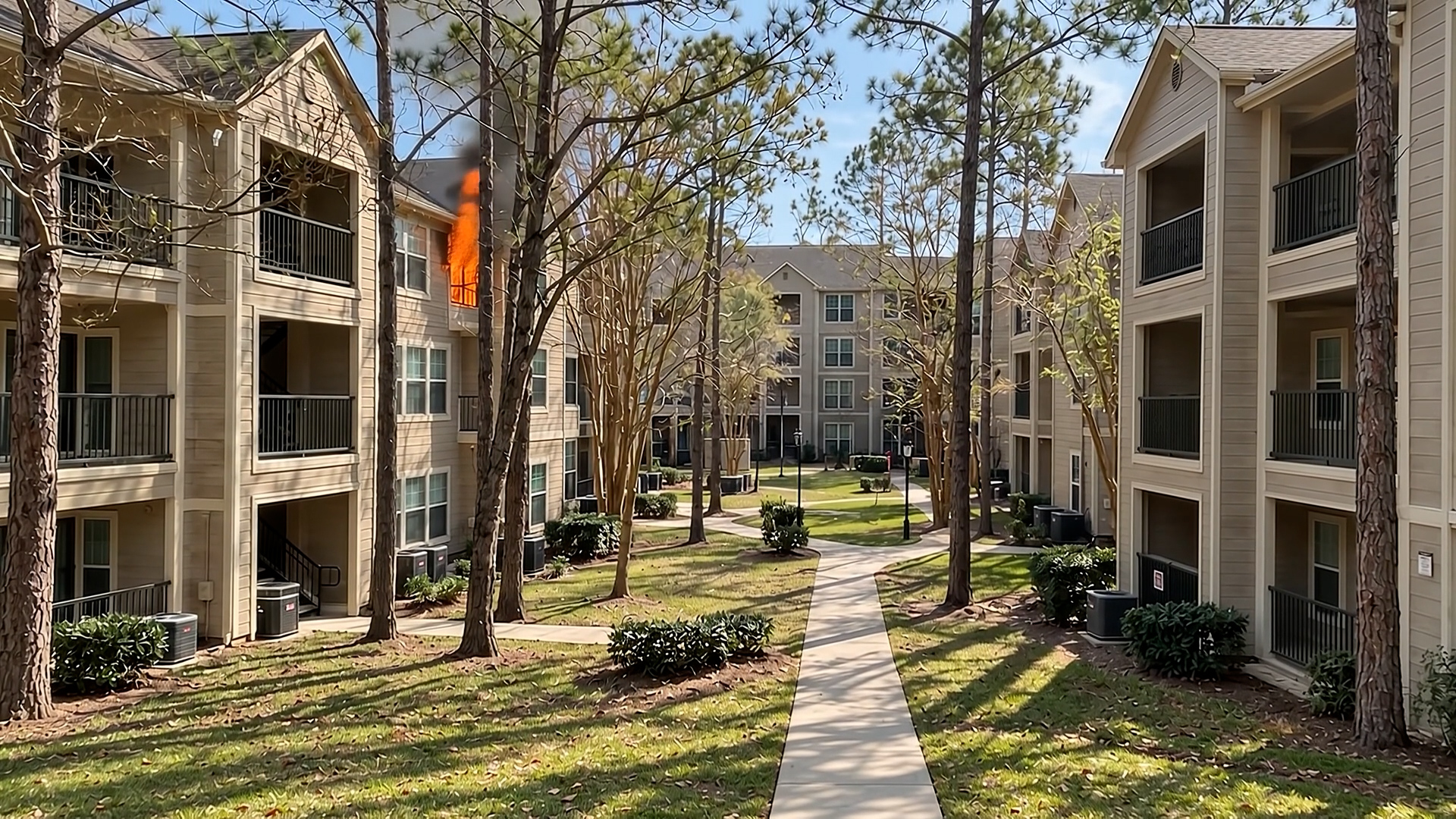
3:35 Narrator: HERE’S THE SCENARIO: A THIRD-FLOOR APARTMENT FIRE DEEP IN A COURTYARD THE ENGINE CANNOT REACH. THE CREW HAS TO GET WATER FROM THE STREET TO THE FIRE FLOOR.
3:45 Mark VanBerschot: We have quite a few garden style apartments in this area. They have exterior stairwells, but access to the buildings can be very difficult because of the courtyard layouts.
3:53 Mark VanBerschot: They’ll have parking and driveway around them, multiple buildings, and then interior, they’ll have either courtyards or other buildings within that courtyard which doesn’t have direct drive access to it. So we end up stretching long hose lays to these interior apartments.
4:09 Matt Ricks: …know, whenever you’re going to come into these situations where you have buildings that don’t have access to them by apparatus, and you have to deploy hoselines or long hoses, that you get out and you train on those, those scenarios.
4:22 Narrator: FIRST, A WALKTHROUGH OF HOW STAFFORD CONNECTS THAT DISTANCE.
4:26 Mark VanBerschot: When a truck pulls up on location, the officer is going to get out. We have two prepackaged bundles at 100 ft each, so we have 200 ft of line. The officer will grab one bundle. He will bring it to the area where he wants the firefighters to make the connection. He’ll drop his bundle. He’ll complete his 360, investigate if they need to move anywhere.
4:45 Mark VanBerschot: The other crew, the rest of the crew will be stretching the other bundle and the 2½” supply line, making the connection here so that the officer can, once he finishes his 360, they can start advancing the hoseline.
4:56 Mark VanBerschot: So it would not be uncommon for us to be 150 ft away, stretching our, our supply line or our 2½” line. And then hook up our apartment lay here, stretch up the exterior stairwell to whatever floor we need to.
5:09 Narrator: SO WHEN DOES STAFFORD CHOOSE THE APARTMENT LAY OVER A PRECONNECT?
5:13 Mark VanBerschot: It’s the length of the lay. If we get into some of these buildings where we know we don’t have direct access from the roadway, very quickly our officers are going to have to decide whether or not to, to use a preconnect, which is only 200 ft, or they’re going to end up using that apartment lay, which allows them 250 ft of 2½” and another 200 ft of apartment lay bundles.
5:32 Narrator: THERE’S ALSO THE WATER SUPPLY TO PLAN FOR.
5:34 Mark VanBerschot: A lot of our apartment complexes don’t have fire hydrants within the complex, so we have to identify those before. Because if we do have a fire in one of those complexes, we’ll have to identify the water supply outside of the complex and call for other units to lay in.
5:49 Mark VanBerschot: …the first or second-in unit take this one, and then we’re third or fourth, then we might end up having to catch our own plug. We don’t all want to be hooked up to the same hydrant because these are large buildings. If it starts to go, we’re going to need multiple water sources, right?
6:00 Mark VanBerschot: All the buildings in here are two and three stories. We do have similar complexes that are four stories, so training on stretching up the stairwell is, is significant part of this.
6:10 Mark VanBerschot: It does have an FDC. This FDC is strictly to augment the sprinkler system. Problem is, is a top floor fire that extends into the attic space. These are common attic spaces that are not sprinklered. So we end up having to deal with a lot of that.
6:23 Narrator: TODAY’S EVOLUTION SHOWS THREE ROLES AT THE BUILDING: ALPHA, BRAVO AND CHARLIE.
6:29 Mark VanBerschot: We never have two. So our minimum staffing is three. But when you only have three-man staffing, the pumper chauffeur is going to be back at the pumper because he’s the one that has to operate the pump. That makes that officer a working officer. We don’t have an extra set of hands like we did with our other firefighter.
6:43 Mark VanBerschot: So if you remove one firefighter out of the equation, you only have three-man staffing on that apparatus. That officer now becomes a working officer. So they are going to help stretching hose up the stairwell, through the hallways. It makes it more difficult for that initial attack. And it makes it a little bit more dangerous because the officer isn’t able to concentrate on the operation and the safety that’s taking place.
7:05 Narrator: TIME TO SHOW THE BLOCKING AND TACKLING OF THE EVOLUTION. PHASE ONE: ARRIVAL AND INITIAL STRETCH. CHIEF VANBERSCHOT WALKS THROUGH WHO GRABS WHAT AND WHERE IT GOES.
7:16 Mark VanBerschot: …an apartment lay, obviously we’re pulling up on an apartment that we don’t have direct access to from the street or the driveway. So we are going to go ahead and stretch our apartment lay. The, starts off with the officer. He’s going to hop off of our apparatus. He’s going to grab one 100 ft bundle of 2″.
7:31 Mark VanBerschot: He is going to walk to a location that he believes is the best point to make the attack from. He’s going to put that bundle down and then try to complete a 360. Use his camera and get the information he needs to get to ensure that he’s making the right decision.
7:44 Narrator: NOW MEET THE CREW DEMONSTRATING THOSE THREE ROLES, STARTING WITH LIEUTENANT MICAH GEORGE AS ALPHA.
7:49 Micah George: Basically, my job was get that initial bundle down on the ground where I wanted to make an entry.
7:55 Micah George: While I put the bundle down, they started making their connections. I did my 360 to see if our best entry point would be Alpha, or if it was a Bravo or Charlie or Delta fire. If it was on the Charlie side, per se, we would initially go entry on Charlie, but I’m doing my 360, making sure my initial size-up is correct. And then I’m meeting up with my guys.
8:15 Mark VanBerschot: Where he places his bundle tells the other firefighter where to place the bundle, and…
8:20 Narrator: ZACHARY GIBSON IS THE BRAVO ROLE IN THIS EVOLUTION.
8:24 Zachary Gibson: …my job in this fire was to get one of the bundles, get it stretched out here, drop it next to where my lieutenant drops his, and I get the bundles connected. And get the initial stretch out, prior to us moving up the staircase. Now, once we move up the staircase, I’m on the nozzle the whole way.
8:40 Mark VanBerschot: …then the chauffeur or the or second firefighter if we have it available, will stretch the 2½” to that location. The firefighters will make the connection from the 2½” to the gated wye… the 2″. And then they will flake it out there.
8:53 Narrator: BRADY MCGINNIS IS IN THE CHARLIE ROLE.
8:56 Brady McGinnis: I was in charge of getting the Minuteman flaked out. It’s the supply line that goes to the 2″ line we have going up the apartment and hooking that up. After that, I was following the firefighter and lieutenant up with more slack so that we can get the 2″ line that goes into the apartment building flaked out.
9:17 Mark VanBerschot: When a truck pulls up and parks, the officer and the firefighter are going to hop out. We have our connections, 100 ft with a smooth bore, another 100 ft with the gated wye. The officer will take one bundle, bring it to the location that he wants to set up, drop his bundle, do his 360. The other firefighter will grab the other bundle, and either the fourth firefighter or the chauffeur, if we’re running short staffed, will stretch the 2½”. The 2½” will go to where the bundle was dropped. That way they can start making their connections. The only thing they have to do is spin off the tip, hook that gated wye directly to that nozzle, and then we can start stretching the handline from there.
9:54 Matt Ricks: We have two bundles, 100 and foot each. One has a nozzle. One has a gated wye. They set up side by side. Nozzle and gated wye are on the outside. Only connection you gotta do is make your middle connection, flip the high rise back, back from the first coupling on each one. And then you take your nozzle and you pick your middle where you connect.
10:18 Matt Ricks: You pull out, the end connects to your 2½”. Spin the nozzle off. Use the bail for your water shut off. Gated wye goes to it, and then that’s it.
10:31 Zachary Gibson: So we’re stretching out our excess hose. Keep it in line for us so it’s not going to tangle up, create any knots or pinch points for whenever we get ready to go ahead and stretch up our staircase.
Interviewer: What’s a common problem you see in this space?
Zachary Gibson: If we didn’t check our stuff prior, our stuff’s not loaded properly.
10:48 Zachary Gibson: Our hose will get tangled. We’ll think we’re grabbing one thing, we’re grabbing another. And then when we do actually charge our line, we end up with kinks. We end up knotted around things, causing us to lose water pressure at the nozzle when we’re trying to fight the fire.
11:02 Mark VanBerschot: So at this point, the firefighters have made all the connections that they need to make with the supply line and the, the attack line. The officer has completed his 360. He’s going to make a face to face with his firefighters. They’re going to go ahead and advance this dry line as close to the fire floor as possible before we charge it.
11:19 Mark VanBerschot: Once they charge it, they have everything flaked out, and then they can start making a push on the fire.
11:23 Mark VanBerschot: By that time the officer should be completing his size-up.
11:26 Mark VanBerschot: He’s going to come back. Make sure that everybody knows what the plan is. And then we’re going to start stretching hose up stairwells into the fire room.
11:33 Micah George: All the smoke and fire is telling me the fire is on the other side. Third Division. So we’re gonna make our stretch to the Third Division.
11:39 Interviewer: So, stretching the hose out here versus trying to stretch it out in that stairwell?
Zachary Gibson: It gave us the extra space where I was able to stretch it out, and I was able to line my 50 foot coupling right up with the staircase. All I had to do was basically stretch my half till it was nice and tight, come back and just hook that coupling. And I was good to go.
11:55 Mark VanBerschot: Off the sidewalk. We try to keep it off the stairwell so that a guy is coming or going, people aren’t accidentally kicking closed valves, tripping over hoselines. So we try to keep it off the side, and the situation is perfect where we can set up right here, stretch out our hose. We don’t have to worry about anybody dealing with the manifold.
12:11 Narrator: PHASE TWO: STAIRWELL ADVANCE AND FIRE ATTACK. THE CREW NOW HAS TO KEEP HOSE MOVING THROUGH THE STAIRWELL AND INTO THE APARTMENT. HERE’S HOW THEY DIVIDE THAT WORK.
12:21 Micah George: Nozzle firefighter, or Firefighter Bravo, all his flaking is going to be on the fire floor. Firefighter Charlie, second firefighter, he’s going to flake most of his hose on the second floor, which is the floor below the fire.
12:34 Micah George: That way, we don’t have all our hose on the fire floor, tripping hazards and other crews coming in and out. We want to limit as much hose on that top floor we can, but we also want enough hose that we can get into the fire room.
12:46 Narrator: ON THE SECOND FLOOR, ONE FLOOR BELOW THE FIRE, HOW MUCH HOSE DOES THE CREW NEED IN RESERVE?
12:52 Mark VanBerschot: The floor below and the stairwell going up to the fire floor is going to have extra hose on it. So we want a solid 50 ft on the floor below. And then we’re going to have as much hose as we can going up the stairwell. And if the fire conditions allow us, we’re going to have extra hose up on the fire floor also.
13:08 Micah George: Like we stated earlier, making sure you have people on individual floors to catch that slack as it rolls in the banister, because it’s going to catch. And each floor at that, at the 90 degree angle where the staircase goes up. So having somebody at each level kind of feeding slack to help the nozzleman so he’s not pulling the full weight of the load, plus the friction of the banister.
13:27 Mark VanBerschot: The most common problem with the apartment lay is going to be the stretches up the stairwells and down the hallways. We generally see guys not pulling enough hose to the floor below or to the fire floor. Once they charge that line, it’s much more difficult to advance charged hoseline. It is something you have to train on, but if you charge that line and you don’t have enough hose on the floor below to help you make that push, you’re not going to move that line easily. It’s going to get much more difficult and take a lot more time.
13:54 Mark VanBerschot: The stairwell is always a pinch point. That’s why I always try to get extra hose the floor below and a little extra on the fire floor. At that point, we can have the backup firefighter humping hose back and forth. He’s going to have to transition from there to here, but as long as he’s got hose stretched out behind him, it’s a much easier push. He can keep pushing hose.
14:15 Narrator: THE CREW FOLLOWS THAT HOSE TO THE APARTMENT. THE CREW EXPLAINS HOW THEY ALLOW FOR THE PUSH INSIDE, AND WHAT HAPPENS IF THEY COME UP SHORT.
14:22 Micah George: Basically, we’re snaking out just like we’re doing on the floor below. We’re snaking out enough hose to make that initial push into the room. That way we have enough slack to cover this whole apartment, or if it extends to the apartment over, we have enough hose to reach that secondary unit, or third or fourth, depending on what the fire’s doing.
14:44 Zachary Gibson: Short stretches are, they’re a pain because there’s really never an easy solution to them. Usually your, your nozzleman’s going to bump back to your doorway of your unit. And he’s going to be kind of by himself. Just kind of keeping that fire back while your officer, your other fireman, firemen from another crew are sitting there either figuring out where we’re losing hose at or bringing up a whole another bundle of hose so we can attach it and have that distance to be able to get in there and make that push that we need.
15:10 Micah George: So once we get it flaked out and where we want to be and how much we want it stretched on the different floors, so we have ease of access while we’re moving that hose into the fire room, that’s when we would, I would radio my driver, and I would tell him, hey, 22 Alpha 22 Delta. I’m ready for water. He would charge the line. I would make sure that he had our valves open so that once the water got through to the gated wye it would continue through and get to the tip of the nozzle. So I would radio him and let him know when we have an adequate stretch and have it flaked out how I want it. And then I would tell him, go ahead and charge water. We’re ready for water.
15:45 Narrator: ALONGSIDE HIM, FIREFIGHTER GIBSON EXPLAINS WHAT HE’S LOOKING FOR FROM THE NOZZLE POSITION.
15:51 Zachary Gibson: He said he’s looking with the TIC to see if he can see anybody. I’m going to try to get down low, below the smoke, see if I can see anything from there. See if that can give me a direction on maybe where the fire’s at. If there is anybody, all that, I’ll usually have my own TIC as well that I’m scanning with.
16:08 Zachary Gibson: I’ll use my TIC, I’ll look up, see if that fire’s there. What kind of heat is above us right now. And then once he gives me the all clear, we’ll start pushing in and just clearing the structure up, finding people, animals, the fire itself, whatever we need to do to get the job done.
16:25 Micah George: I’m more than confident that we make this fire room and any additional rooms. The only thing that would change our tactic is if it jumps in the next staircase. We have to either stretch an additional apartment lay to the next unit, or take this down and reposition on the other fire.
16:44 Micah George: The other, other floor, the other staircase. That would be frustrating, because we just spent all this effort stretching it here, and it’s already bypassed us. So I would maybe radio, get another crew going. If we don’t have another crew, then that’s on us. We’ve got to make the stretch to the next unit, and we just got to make it work.
17:00 Narrator: PHASE THREE: ATTIC SPREAD AND TOUGH DECISIONS. ABOVE THE THIRD-FLOOR APARTMENTS, A COMMON ATTIC GIVES THE FIRE ROOM TO SPREAD. THE CREW’S CHALLENGE NOW EXTENDS BEYOND THE ORIGINAL FIRE UNIT.
17:14 Mark VanBerschot: Our biggest issues, most of our apartments in this area were built in the ’80s and ’90s. Almost all of them have common attics. Almost none of them have sprinklers in the attic space. So if we have a top floor fire, the biggest situation we run into is fire involvement in the attic space.
17:30 Mark VanBerschot: And once it gets ahead of us, it’s a losing battle. So we have to take that as priority to try to get ahead of the fire. We see a lot of it in our building construction.
17:38 Mark VanBerschot: The longer it takes to get water on the fire, the faster that fire is going to continue to grow. Once it gets, especially top floor fires, once it gets up in that attic space. In our territory, the vast majority of these apartment complexes have common attic spaces with no fire break.
17:52 Mark VanBerschot: So if it gets into that attic space, it’s off to the races. We need to make sure that we’re getting our line in place in a timely fashion to keep that from happening.
18:00 Mark VanBerschot: Yeah. At that point, you’re, you’re fighting a losing battle. If it’s a wind driven fire and it’s already made it past you, the best option is to back out and restart. What we really concentrate on here is recognizing those situations before we make that push. If we know that we’re going to have a reflex time of minute to minute and a half to get water onto that fire, and that fire is advancing faster than we can get up there in that minute and a half, that’s when we’re going to donate some real estate, move down to the next stairwell, go over 1 or 2 apartments, try to get into the space to cut it off, because if we don’t cut it off, then we lose the entire building.
18:31 Mark VanBerschot: It is very easy for us to get distracted and go directly to the fire. But there are situations, like you said before, with the wind driven fires or a well-established fire. It may not even be wind driven, it might just be a delay in response or a delay in notification where now when we show up, we already have 3 or 4 units involved.
18:47 Mark VanBerschot: If 3 or 4 units are involved, you are going to have to get ahead of that fire because one handline is not going to put those apartments out. So that’s when we have to start making those calls to maybe move ahead of the fire, try to cut it off.
18:58 Mark VanBerschot: It’s very difficult. And if it was your apartment that I was letting go, you would be extremely upset. But at the same time, there’s 10, 20, 30 other families who we are saving. And it is a very difficult call to make. But it’s your job as a company officer, as a chief officer, to make those decisions, and you’re going to have to live with them.
19:15 Mark VanBerschot: In this situation, if we have heavy fire involvement in that unit, we do not want to start at that unit.
19:22 Mark VanBerschot: We may choose to go up the other stairwell and start in this unit, donating this real estate, because we know with our reflex time, by the time we get to the third floor, that unit’s already going to be well involved. And if it’s in the attic space, it’s ahead of us. Now we end up losing the entire building.
19:38 Mark VanBerschot: This is a scenario where it works out perfectly, where the first line has to have the option to go up ahead of the fire, possibly donating some real estate to save the building. If we don’t get ahead of it, it runs away on us when we lose the whole building. All 24 units.
19:54 Narrator: BACK AT THE STAIRWELL, THE CREW WALKS THROUGH THE SIGNS THAT WOULD MAKE THEM CHANGE THEIR ATTACK POSITION.
20:00 Mark VanBerschot: So we’ve stretched our apartment lay. We’ve made our connections downstairs. We stretched hose up to the fire floor. We realized that it may be a wind driven, a fire, or it’s more advanced than we expected. If it is a top floor fire, we are worried about attic space involvement and then stretching the entire length of the building.
20:16 Mark VanBerschot: Occasionally we’re going to have to redeploy where we either have to take this line back down to cut it off in another stairwell or another unit, or in order to defeat the moth to a flame, we may have to make that call from the very get go. Instead of going directly to the fire, we may go down to the next stairwell.
20:34 Mark VanBerschot: A couple of units over, make our attack from that location, donating a little bit of real estate to save the rest of the building. With a wind driven fire, by our reflex time puts us in a position where we could be struggling to get our line in place before the fire overwhelms that area.
20:50 Micah George: So if I’m starting to see a lot of smoke in this unit, a lot of heat also stretch into the other unit. And then across behind us, the units across the hallway. If I see smoke coming out of the doors there, I know it’s advanced over top of us, and it’s starting to hit those other units, that we aren’t in prime real estate anymore, that we need to take a step back, rethink our tactics, and maybe, like Chief VanBerschot was saying, reallocate some real estate so that we can put our hoses in a better location to stop the fire and save more units.
21:19 Micah George: It depends on how fast the fire is moving. If it’s moving really fast, I’m on a radio command. “22 Alpha Command. It’s progressed past me. I’m going to need another apartment bundle the units next to us.” And then he can start working, getting that accomplished. We can start working our way down with our bundles. And either we beat the other crews there and start knocking the fire out in those better locations, or we go up with our bundle and kind of have more lines to attack whatever we’re dealing with, because it’s going to be pretty, pretty advanced at that point.
21:52 Micah George: So we’re going to have a lot of fire, a lot of heat, so they can be knocking out one unit while we go to the next unit, start knocking that out.
21:58 Micah George: We might even just leave this be, reallocate our line, take it back down to the ground level, and move over to those other apartments to assist the other crew.
22:07 Micah George: Or, we’re the only crew doing it. Move our lines so that we can start knocking the fire out and start taking back some of this real estate that the fire is taking.
22:15 Mark VanBerschot: Understanding your territory and your building construction. It’s one of the biggest things that we can use to make that decision. If I know that there’s sprinklers in the attic space, it does buy me some time. So maybe I don’t have to give up as much real estate. But if I also know my construction doesn’t have it or it’s lightweight truss with wide open spaces, then now I’m dealing with a different beast and I have to. I have to work to get ahead of that fire.
22:36 Mark VanBerschot: One of the things he was discussing about moving on to the next unit, the first-in company needs to have that authority to be able to make that decision when he arrives. If we are waiting for chiefs to show up to tell us to redeploy or move ahead of the fire, we’ve probably lost that battle already. So having the authority as a first-in company to make that decision will save real estate.
22:54 Narrator: THAT DECISION FALLS TO OFFICERS WORKING UNDER PRESSURE. CHIEF VANBERSCHOT EXPLAINS HOW STAFFORD PREPARES THEM TO MAKE THE CALL.
23:02 Mark VanBerschot: Training and scenario situations. We really rely on experience. So when our officers get to the point where they’re actually able to make those decisions, we have to be able to give them the authority. As chief officers, we have to give our company officers the authority to make that decision and rely on their experience and their training, because that is an extremely difficult decision to make, possibly giving up a unit that’s not involved yet, but understanding how long it’s going to take to get that line into a place through training and previous experience allows them to make that decision.
23:32 Narrator: NOW THE EQUIPMENT. HERE’S HOW STAFFORD BUILDS THE LINE FROM THE ENGINE ALL THE WAY TO THE NOZZLE.
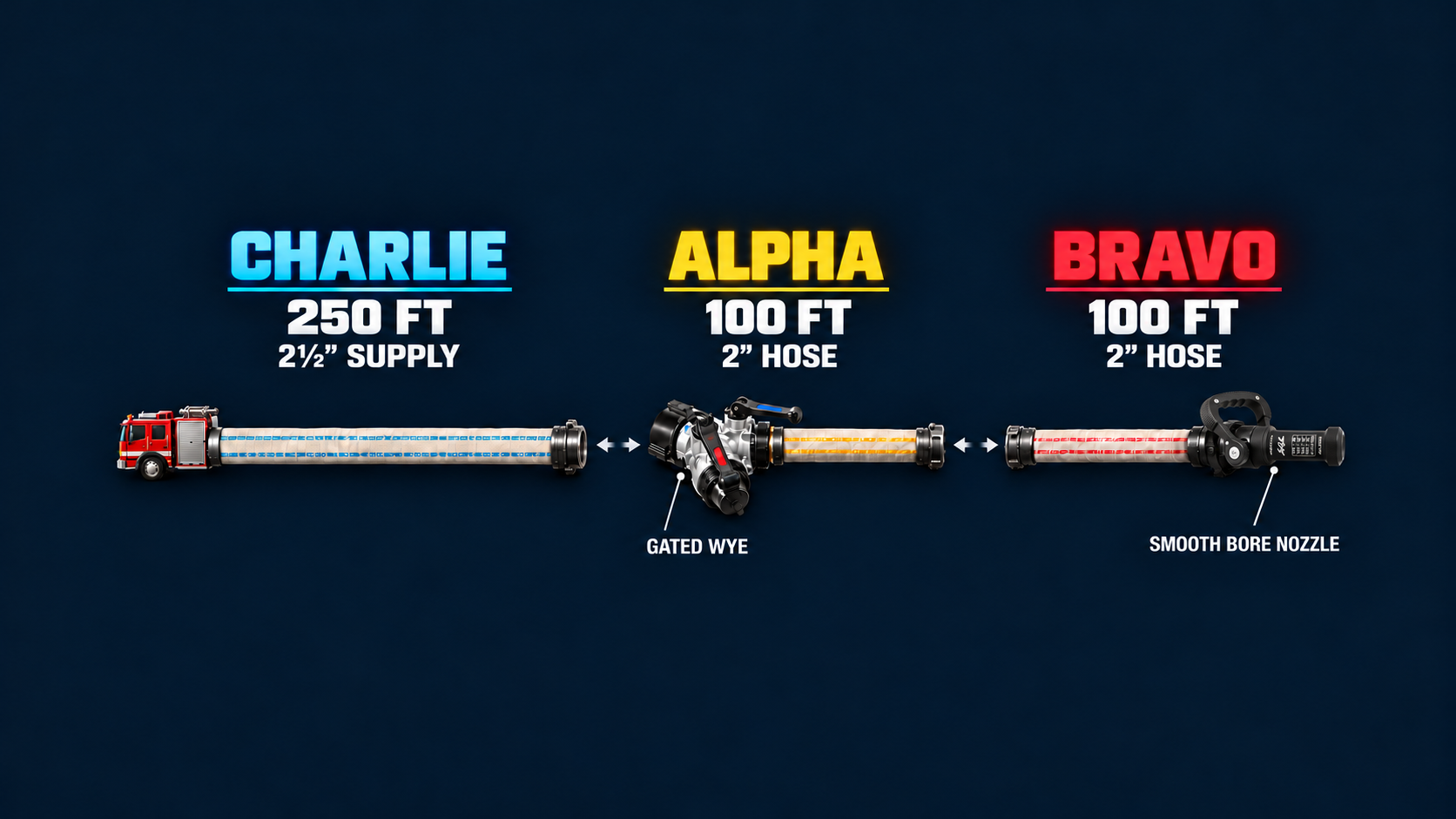
23:39 Mark VanBerschot: Our apartment lay is going to be a 2½” supply line… have a gated wye, and that gated wye is going to connect to another 200 ft of 2″ line. Those 2″ line is broken into 100 ft bundles. So we have two 100 ft bundles that we make a connection with. And then we stretch that off of our 2½”.
23:56 Mark VanBerschot: …you look at a standpipe running through a building, it could go anywhere from three stories up to 103 stories. For us, we run it horizontally, so we may be 6, 7, 800 ft away from the pumper, but we have that water supply running the entire length. And then we work off of that with a gated wye.
24:12 Mark VanBerschot: We try to use, for our apartment lays, we use 2″ handlines. It does decrease the friction a little bit. We use smooth bore nozzles, so they are low pressure nozzles. But we’re still getting the GPMs that we’re looking at, trying to get between 175 and 200 gallons a minute. Ideally we’re pushing 15/16″ tips, generally getting 185. Sometimes we’ll have a 1″ tip getting 210 gallons a minute.
24:33 Mark VanBerschot: So between the 2½” hose and the 2″ hose and the, the low pressure nozzles, with the smooth bore, we’re able to keep our friction loss and our pump pressures down.
24:42 Mark VanBerschot: If this fire gets away from us and we have multiple handlines in play at 3, 4 or 500 ft, now all of a sudden our friction loss is to the point where we’re going to have to overcome it some other way. We might have to relay pump or find another way to bring water to the system.
24:56 Mark VanBerschot: …our supply lines, we use 2½” to supply our apartment lays for the simple reason that we carry a lot of 2½” on our pumpers, so that 2½” supply line can supply 500 gallons a minute, which is more than what we pump on two handlines. So it allows us to, to get that water downstream pretty quickly.
25:17 Mark VanBerschot: We do have to figure in friction loss once we start pumping multiple handlines off of one 2½”. But it’s something that we work on.
25:23 Narrator: SOME CREWS MIGHT SAY, “JUST PUMP HARDER.” BUT WHAT DOES THAT MEAN FOR THE FIREFIGHTERS MOVING THE LINE?
25:29 Mark VanBerschot: Yeah. They can. I mean, obviously the more pressure you pump, the, the harder it does, the harder it is to move that handline. I’ve worked for departments where they pump 200 PSI to a handline, and it’s like walking around with a 20 ft pike pole. You can’t bend the line. You can’t get it into operation. All you’re doing is beating your firefighters up.
25:46 Mark VanBerschot: And to achieve the same thing, we’re looking for 185 gallons a minute on the fire. If I need to pump more than that to get 185, I will pump what I need to to get 185, because that’s what we need on the fire. I don’t need to pump more than that.
26:00 Mark VanBerschot: We have minimum staffing. So if, if you only got three people on a pump or on a truck, that’s all you got when you’re stretching hose. So the more difficult you make it on them by increasing those pressures, then the more difficult it is to get the water where it needs to be.
26:14 Micah George: Typically we run longer handles and they get broken. They have a likelihood of being shut off. So having these shorter valves is a lot better, or less likely to get kicked or hit. And also, you know which, which way is open because it’s pointing to it. Less damages and less potential hazards with losing your water supply.
26:35 Mark VanBerschot: …short handles are nice because there’s less chance of people kicking them as they’re walking past, or if they’re in stairwells or interior or hallways. If it’s a low, low light conditions or low visibility, you have firefighters stepping on those handles and they do have a tendency to break off the longer the handle…
26:51 Mark VanBerschot: …in the past, there are departments in this area that do use manifolds, but we were just not seeing the need to stretch more 2½” line past that manifold. So generally we just stuck with the gated wye. It was less equipment, less cumbersome, easier for guys. We have a staffing problem. So anywhere else in the country that has low staffing, you need to, to try to get the best equipment there as quickly as possible. And if you’re bringing in extra large manifolds, then all you’re doing is slowing the operation down.
27:17 Micah George: Typically I know there’s a wye on the, the bundle itself. But we usually take the tip off, attach the wye to this because it’s a lot quicker to take this tip off than to screw the whole nozzle off. So we’ll take this tip off. Put the wye directly on, on the nozzle itself.
27:33 Interviewer: What tactical advantage is that?
Micah George: Quicker, it’s quicker. So instead of taking this whole thing off, picking it up, spinning it off, you just spin this off, attach the wye. It’s a little more. We’re a little more proficient in doing that. It’s a little quicker. It does add a secondary so we can keep the wye open because this will become our main water shut off.
27:52 Micah George: So when they make the connection, they’ll open this nozzle, the bail. And, we’re good to go because we leave the wye open.
28:00 Narrator: WITH THE EVOLUTION COMPLETE, THE CREW TURNS TO PREPARATION AND HOW STAFFORD TRAINS FOR THE BUILDINGS AND PEOPLE IN ITS DISTRICT.
28:08 Mark VanBerschot: Yeah, you got to train on it. It really comes down to the training aspect of it. It’s, you can utilize the same scenario, do the same scenarios that we’ve been doing, utilize the same loads that we have. But it really does depend on your territory. It depends on your geographical features. Your, we have a lot of nursing homes in this area or elderly living in this area.
28:28 Mark VanBerschot: Just, I mean, implementing the fact that we might have a 55 plus community and everybody in that building is going to need assistance getting out of the building. You take that exact same fire in a standard apartment complex where it’s usually younger families, may not have those issues that you have with the elderly community. So depending on where you’re at, the makeup, demographics.
28:49 Mark VanBerschot: It all changes. You have to get out and practice it.
28:53 Mark VanBerschot: Always. You’re never going to be able to predict. You can, you can understand building construction and fire science and put it all together and give yourself the best opportunity. But there’s always going to be the factors that you don’t know about that you have to, you have to pay attention to. They may not show themselves until late into the game, but you have to recognize it when you get to that point.
29:11 Mark VanBerschot: …you would think the simple things like making coupling connections and putting the wrong, you know, putting the right coupling onto the right hose. It gets difficult under those situations when they’re not dialed in, and it is, the only way you can get there is by continuously training on it so that these guys can do it at 3 a.m., you know, in their sleep without having to worry about it.
29:31 Narrator: FOR JIMMY ASTON, EVERYDAY CALLS ARE ALSO A CHANCE TO LEARN THESE COMPLEXES BEFORE A FIRE.
29:37 Jimmy Aston: 80-90% of our runs are going to be EMS calls. So that’s when you do your pre-planning, is when you go to these complexes and you make your EMS runs. That’s when you say, when the EMS is there, you can take a step back and go, hey, man, what would we do in this situation?
29:52 Jimmy Aston: So that’s, that’s what I usually tell the new guys. Sometimes you got to pump the brakes on the EMS calls and really focus on. Sometimes we don’t go to those complexes all the time. Every once in a blue moon. So that’s when we, you know, take advantage of that.
30:06 Narrator: SO WHAT ABOUT USING A GROUND MONITOR ON THESE APARTMENT FIRES? HERE’S HOW THAT FITS INTO STAFFORD’S APPROACH.
30:12 Mark VanBerschot: It’s generally not our go-to tactic. We will do transitional attacks, but it’s usually with a handline. We’re not, we’re usually not hitting it, not with garden style apartments, for the simple fact that once you put that monitor in place, our water supply is going to go. We’re going to go through our water very, very quickly, and establishing a water supply in a lot of these apartment complexes can take some extra time.
30:32 Narrator: WHAT WOULD CHIEF VANBERSCHOT SAY TO A CREW THAT THINKS THIS SETUP IS TOO COMPLICATED?
30:37 Mark VanBerschot: They just got to work on it. If they, if they have a better method, I’m all for it. I mean, please make a video of it, put it out there. I want to see it because I’m all for picking up somebody else tactics if it makes sense in our territory. Not everything works in every territory. It depends on your staffing, depends on your building construction, depends on your apparatus, your hose, all of it.
30:54 Narrator: THE WORK STARTS WITH KNOWING YOUR COMPLEXES: WHERE THE ENGINE CAN STOP, HOW THE LINE WILL REACH THE FIRE, AND WHERE THE CREW CAN MOVE IF CONDITIONS CHANGE.
31:04 Narrator: AND TO WIN THIS SCENARIO IN YOUR DEPARTMENT, HEAD TO TFT.COM/DEMO TO SEE THE EQUIPMENT WITH YOUR OWN TWO EYES.
In Episode 16 of Fully Involved, Assistant Chief Mark VanBerschot and the Stafford Fire Department demonstrate how to stretch an apartment lay when a garden-style apartment fire is beyond the reach of a standard preconnect. At a complex outside Houston, Texas, the crew builds a horizontal standpipe using a 2½-inch supply line, a gated wye, and two 100-foot bundles of 2-inch hose. VanBerschot walks through the initial stretch, stairwell advance, and fire attack while addressing a tougher decision: when to move ahead of a fast-moving attic fire to protect the rest of the building.
Location: Stafford, Texas
Stations: 3
Area: 10 square miles
The Stafford Fire Department responds to approximately 4,000 calls annually. Its shift staffing consists of a lieutenant and three firefighter/EMTs.
When the fire is beyond the reach of a standard preconnect, Stafford builds an apartment lay. A 2½-inch supply line feeds a gated wye, with two 100-foot bundles of 2-inch hose forming the attack line.
The setup creates a horizontal standpipe that lets the crew extend its reach into a garden-style apartment complex and advance to an upper-floor fire.
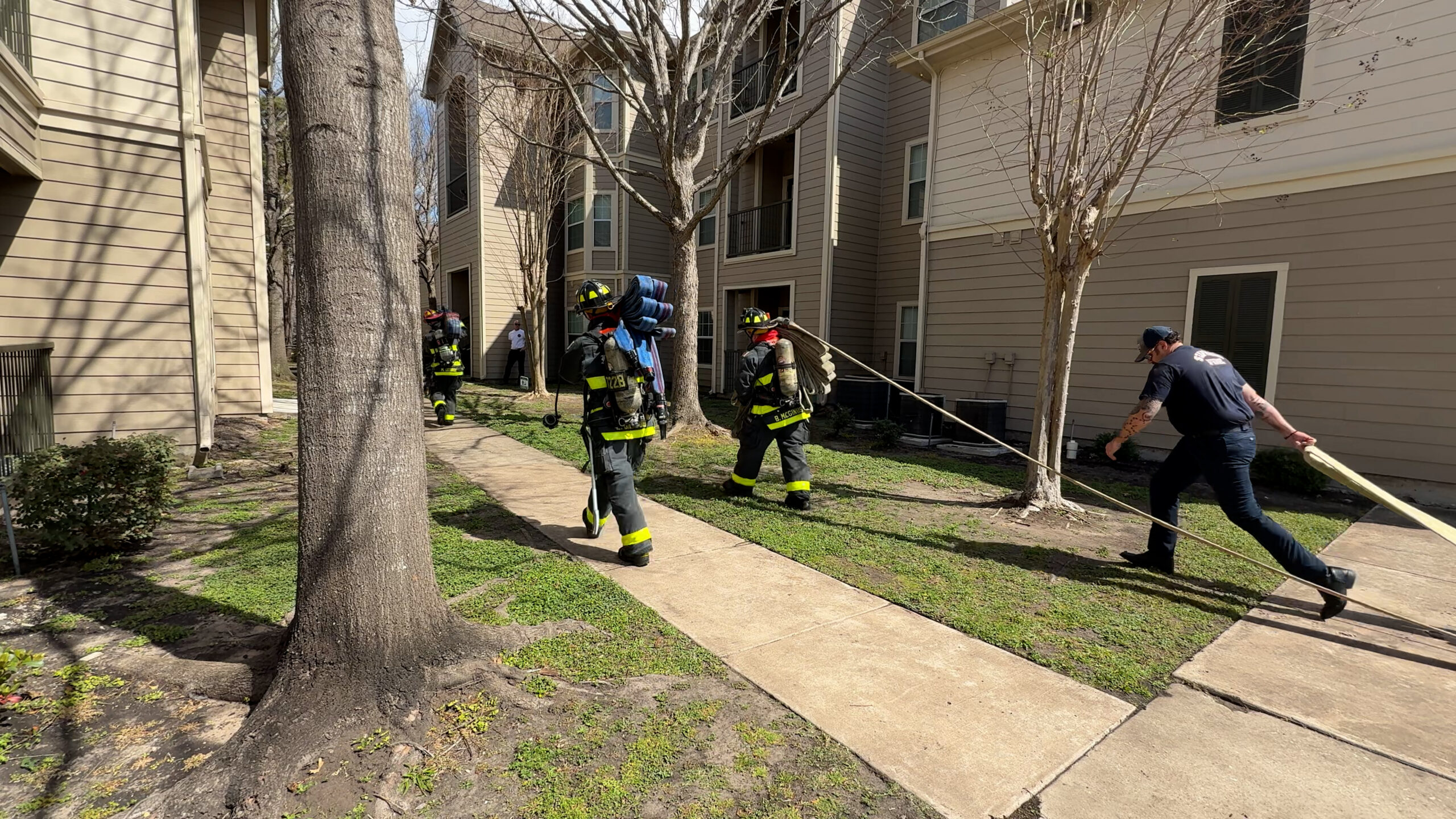
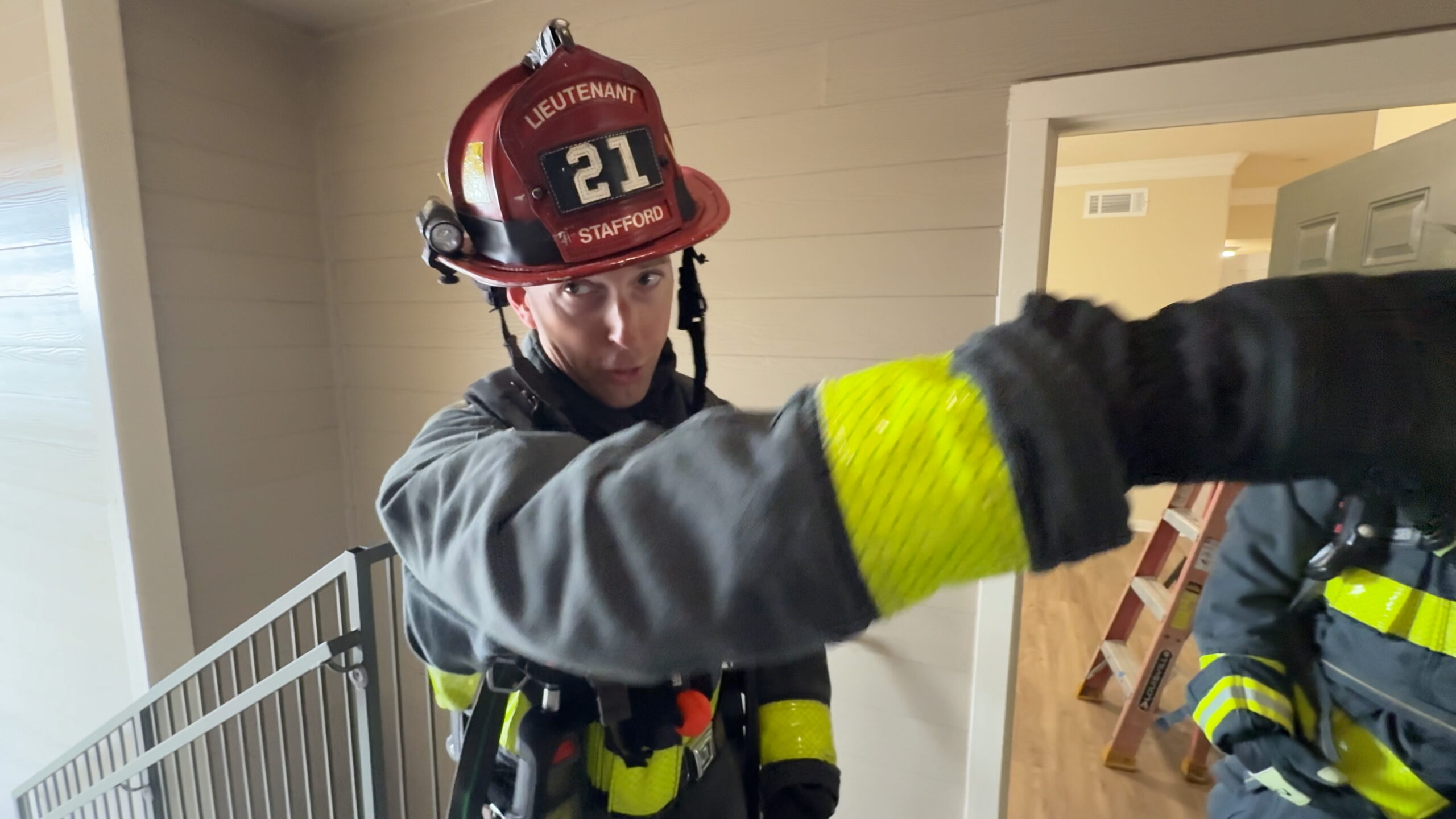
Lieutenant Micah George carries a 100-foot bundle of 2-inch hose to the planned attack location. After placing the bundle, he completes a 360-degree size-up, using his thermal imaging camera and the smoke and fire conditions to evaluate the building. The size-up may change the entry point before he confirms the attack plan.
Firefighter Zachary Gibson carries the second 100-foot bundle, positions it, makes the connections, and flakes the attack line. He removes twists and checks for kinks before taking the nozzle for the stairwell advance and fire attack.
Firefighter Brady McGinnis stretches the 2½-inch supply line to the apartment-lay connection. He helps prepare the attack line, then feeds hose toward the stairwell so the advancing crew has the slack it needs.
Stafford places the gated-wye connection outside the stairwell in an open area. It remains accessible while staying out of the main entry path.
A connection beside the stairs can create a trip hazard. Traffic through the entry can also strike a valve and accidentally close it.
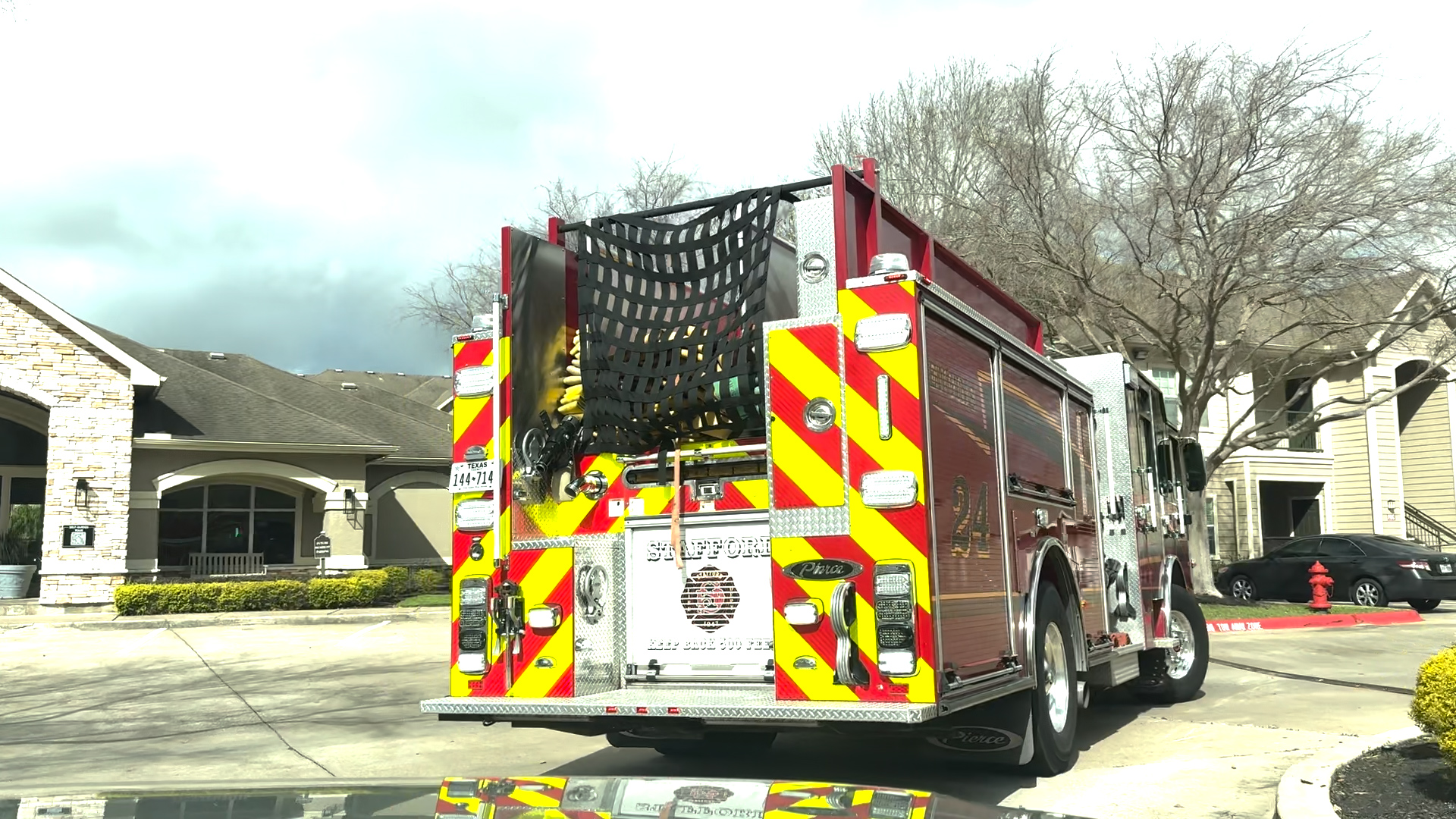
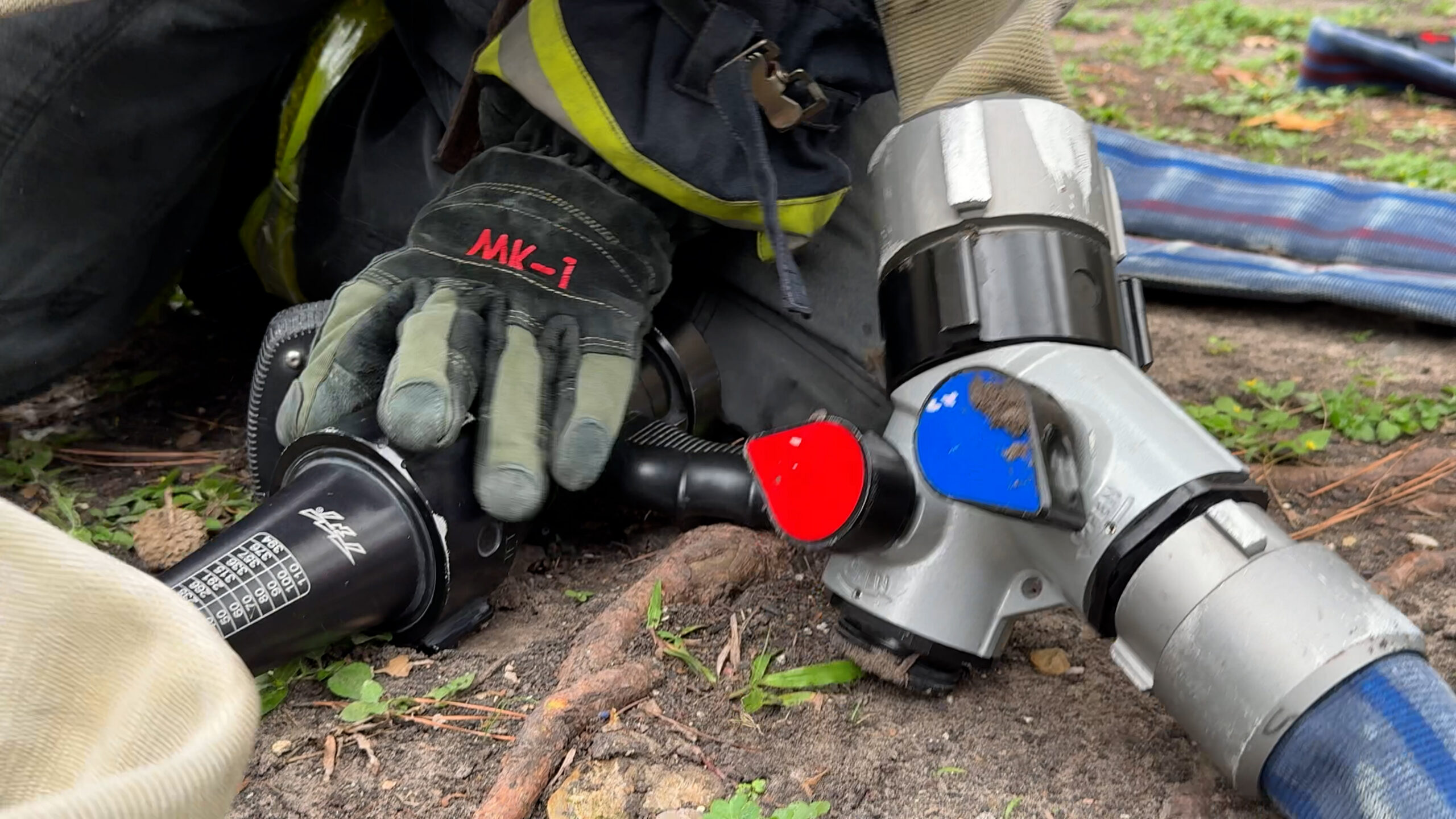
In the demonstration, the crew advances the hose dry so it can be positioned through the stairwell before charging. For the third-floor fire, approximately 50 feet of hose is staged below the fire floor.
Bravo positions the hose needed for the fire-floor advance while Charlie feeds slack from below. Stairwell turns can create kinks and slow the stretch, so hose management continues throughout the advance.
The crew charges the line after enough hose is positioned for the attack. The goal is to have usable hose ready to move.
A fast-moving attic fire can get ahead of the original stretch. VanBerschot describes the decision to give up some area in order to protect the rest of the building as “donating some real estate.”
That may mean moving one or two apartments ahead or repositioning at another stairwell. Smoke and heat in adjoining units, overhead fire spread, or fire reaching the next stairwell can signal that the original position is no longer ahead of the problem.
The decision connects hose placement with the larger goal: stop the spread and protect the remaining building.
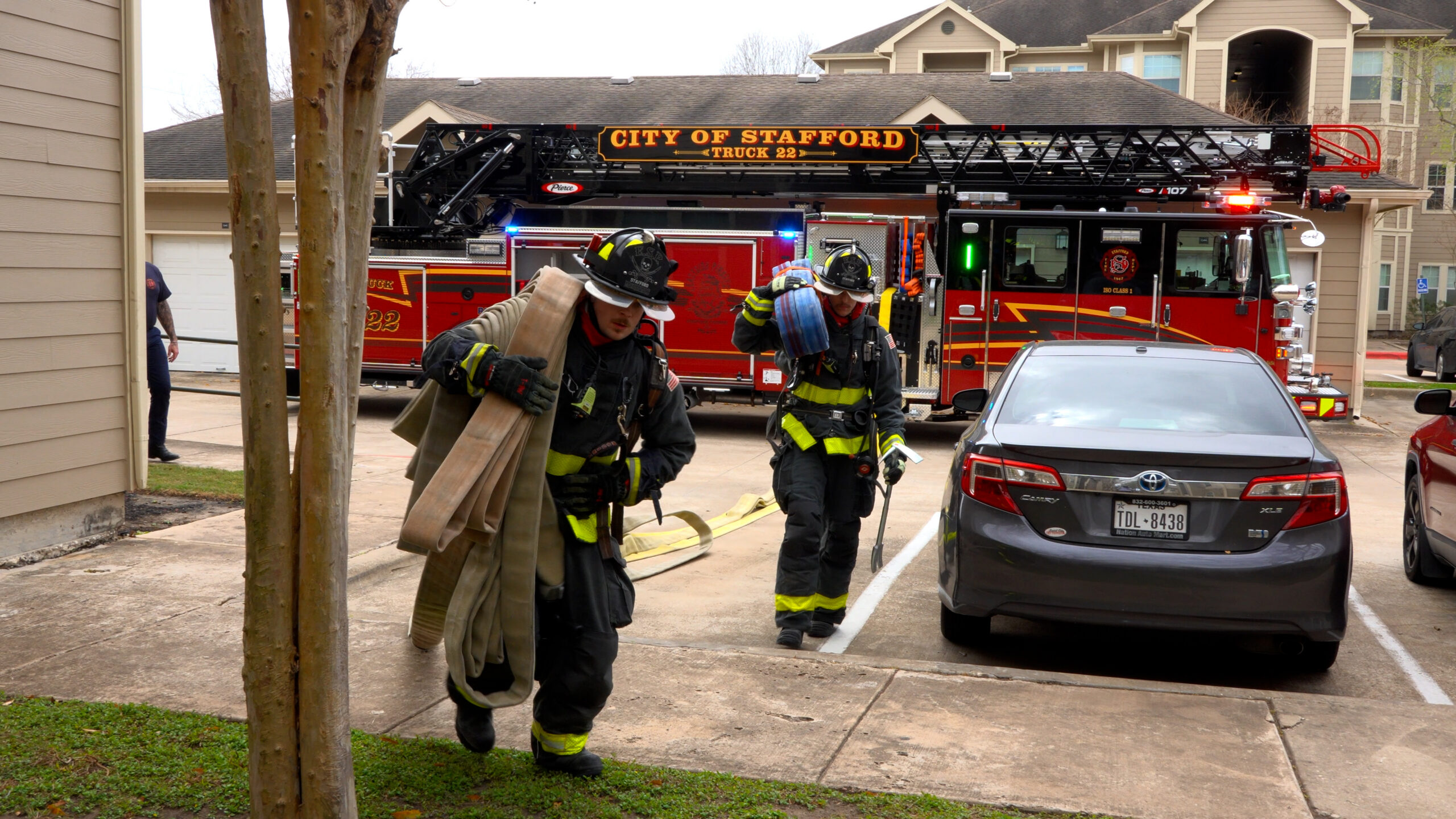
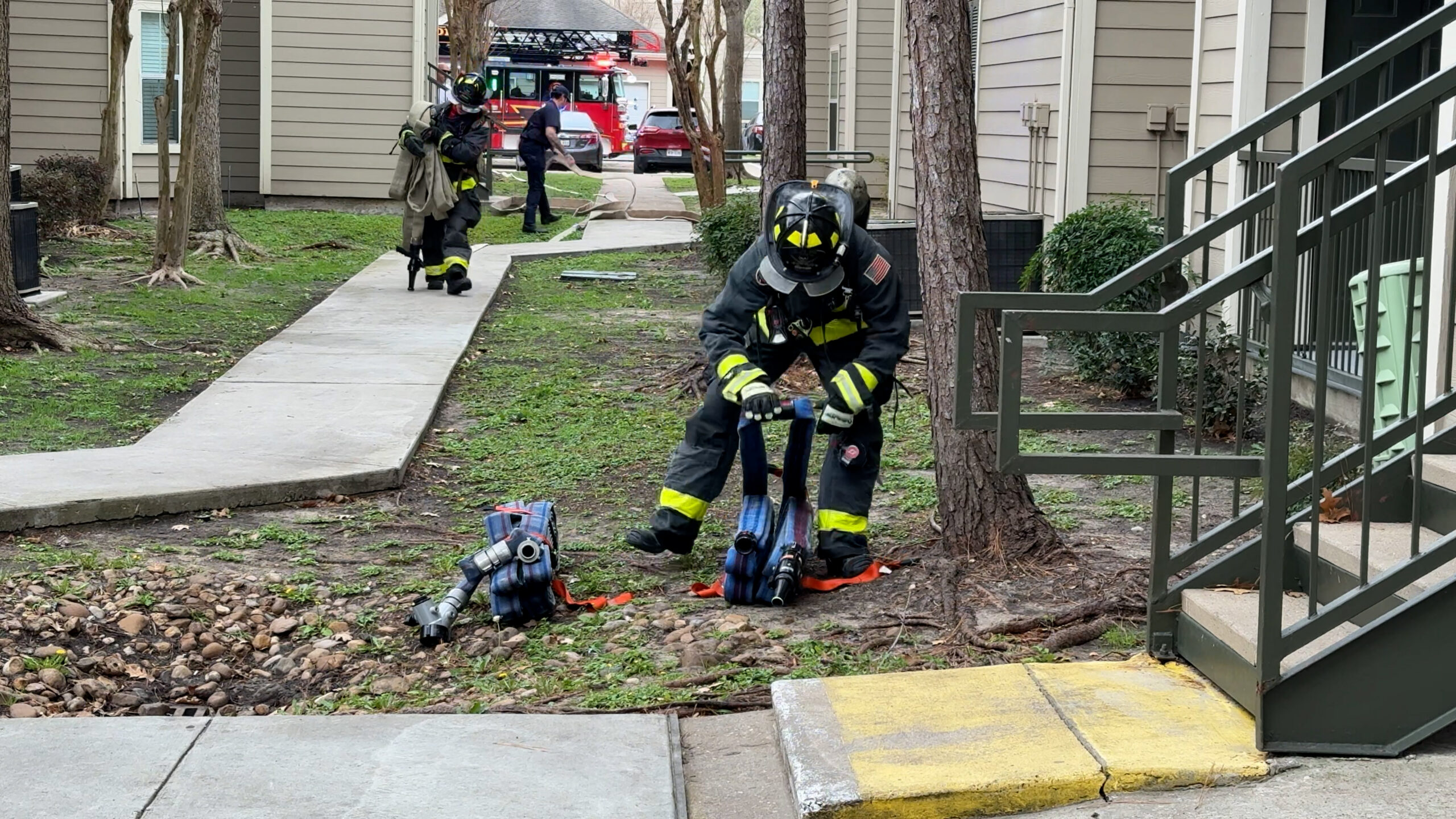
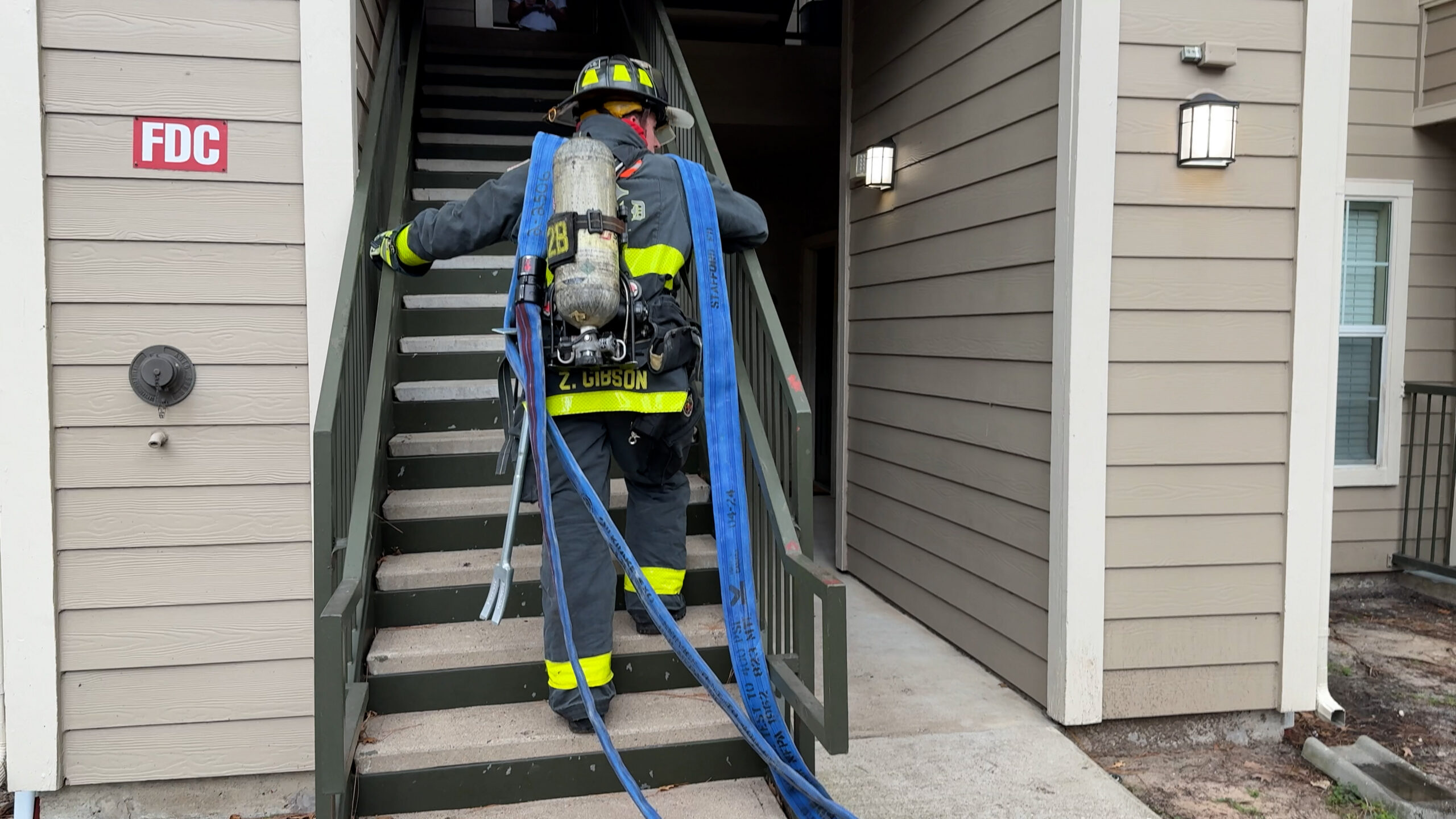
The apartment-lay package demonstrated in the episode includes a 2½-inch supply line, a gated wye, and two 100-foot bundles of 2-inch hose.
The smoothbore nozzle options discussed are a 15/16-inch tip flowing approximately 185 gpm or a 1-inch tip flowing approximately 210 gpm.
Practice the stretch in actual buildings, including stairwell turns and upper-floor advances. Use the department’s hose loads and real staffing so the drill reflects what will arrive on the call.
Build changing conditions into training. Consider common attics, building access, evacuation, and the possibility that the attack will need to move ahead of the fire.
EMS calls can also provide opportunities for preplanning: observe access, stairwells, building layout, and the challenges a future hose stretch may face.
Stafford’s apartment lay combines the right hose package with clear assignments and coordinated hose management. The stretch starts with size-up and continues as conditions change.
The lesson goes beyond getting a line to the third floor: stage before charging, recognize when fire has moved ahead, and train for the buildings in your response district.
No one fights fires like your department. This is your chance to highlight your crew's aggressive tactics and unique responses.